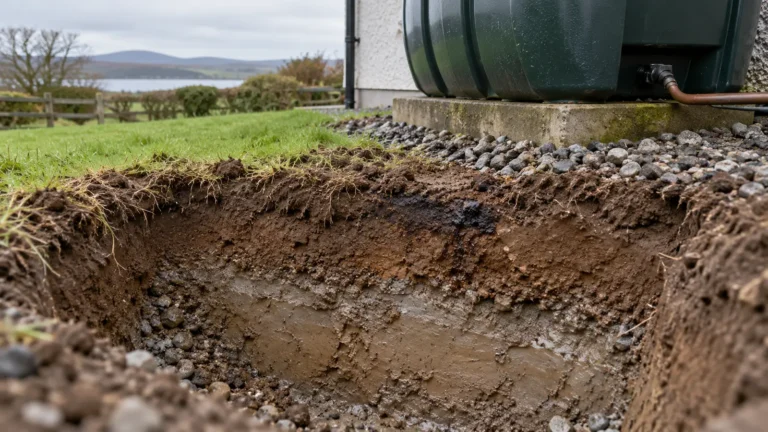

Where does oil-contaminated soil go, and how is the waste classified?
The short answer
Oil-contaminated soil may go to an appropriately authorised treatment, recovery or disposal facility, depending on its characteristics and the facility's permissions and acceptance requirements. Its route cannot be chosen from appearance or smell alone. The contractor should arrange competent classification, suitable transport and the required records. Waste classification, a facility's acceptance testing and verification of the ground left at your home are separate decisions. Keep evidence of all three where they apply.
When contaminated soil leaves a property, the homeowner may see only a lorry, a load and an invoice. Behind that movement should be a clear account of the material, its classification, the authorised route and the destination. Understanding those records helps you ask useful questions without trying to become a waste-classification specialist.
By Spill-Response Editorial Team · Sources checked: 26 October 2026 · Northern Ireland focus
In this guide
- Begin with a description of the actual material
- What waste classification means
- Why a laboratory result needs interpretation
- Waste acceptance testing answers another question
- Where the soil may go
- Check the carrier and the receiving route
- Understand transfer and consignment records
- Do not overlook the ground that remains
- Your practical checklist
- Your next step
- Sources and further reading
Begin with a description of the actual material
“Soil from an oil spill” is a useful starting point, but it may not be a complete waste description. Ask which area it came from, what it contains and whether different materials are being kept separate. Soil, rubble, absorbents, free liquids and removed equipment may require different assessments and routes.
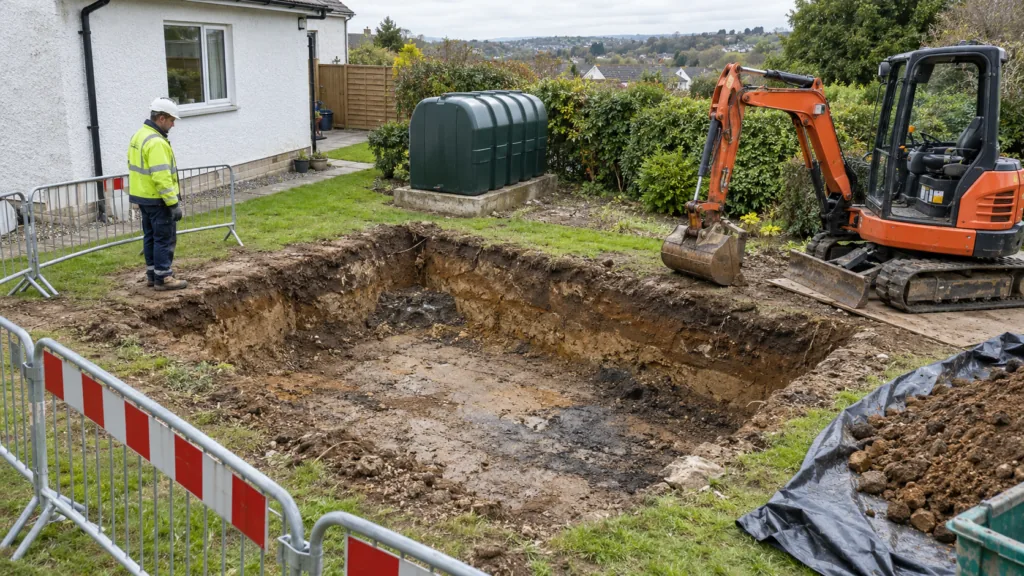
The record should connect a stockpile or load with the investigation and excavation area. If conditions change during the work, ask whether the description and proposed route need reviewing. Material from a newly discovered area should not silently inherit assumptions made for a different part of the site.
Before excavation begins, ask where material will be held temporarily and who is responsible for preventing escape. Do not assume that putting it in a skip resolves all storage or classification questions. The method should suit the actual material and the working area.
What waste classification means
DAERA publishes WM3 technical guidance for Northern Ireland. In its list of waste entries, soil and stones containing hazardous substances are associated with 17 05 03*, while soil and stones other than those covered by that entry use 17 05 04. The assessment determines the appropriate entry and hazardous properties; the code should not be guessed from a fuel smell. [1]
These paired entries are often described as mirror entries. The practical point is that the assessor needs sufficient information about composition and relevant hazardous properties to reach a justified classification. A homeowner should request the classification and its basis rather than select the apparently cheaper code.
The term “hazardous waste” describes a waste-management classification. It does not mean that every brief encounter with the material has caused harm. Conversely, a non-hazardous classification is not permission to handle or reuse the material without considering the relevant controls and intended use.
Why a laboratory result needs interpretation
A laboratory provides results for the samples and analyses commissioned. The person classifying the waste must decide how those results, knowledge of the material and any other relevant information support the classification. Ask who has accepted responsibility for that assessment.
Check that samples represent the material being moved. A result from one small area is not automatically representative of every load from a larger excavation. Ask how different soil types, changing conditions or separate stockpiles are addressed. The sampling approach should be explained sufficiently to connect the result to the waste.
Do not judge the assessment solely by the number of laboratory pages. Ask for a short written conclusion identifying the waste description, code, hazardous status and any limitations. Supporting certificates should remain available, but they should not leave you guessing which conclusion the contractor reached.
Waste acceptance testing answers another question
Waste acceptance criteria, commonly shortened to WAC, concern acceptance at particular types of landfill. WM3 expressly distinguishes leaching tests used for WAC from hazardous-waste classification. [1] A report headed “WAC” therefore should not be treated as a substitute for the classification assessment.
The chosen facility may need specific information or tests before agreeing to accept a load. Ask the contractor to confirm acceptance against the correct description and route. Classification alone does not guarantee that any particular treatment or disposal facility can take the material.
| Document or decision | What it should explain |
|---|---|
| Waste classification | What the waste is and its assessed classification |
| Facility acceptance | Whether the selected destination can receive it on the proposed basis |
| Movement record | What moved, through whom, when and where |
| Remediation verification | What the work achieved at the property |
If someone says the soil “passed”, ask which of these decisions they mean. A precise answer avoids a common misunderstanding: material accepted by a facility has not thereby proven that the remaining ground at the house meets the cleanup objectives.
Where the soil may go
The appropriate route depends on the assessment and available authorised facilities. Ask whether the proposal is treatment, recovery or disposal, and obtain the facility's identity. If treatment is proposed, ask what record you will receive of acceptance or processing. Avoid assuming that all contaminated soil must go directly to landfill.
A facility name on a quotation is not a guarantee that every later load will go there. Ask how changes will be approved and recorded. If the first destination cannot accept the material, the revised route should remain traceable rather than becoming an informal arrangement on the day.
Cross-border movements can introduce additional requirements. Tell the contractor if you are being offered a destination outside Northern Ireland and ask who will check the applicable controls. Rules and paperwork should not be copied from an English or Irish example without confirming that they apply to the actual movement.
Check the carrier and the receiving route
DAERA's duty-of-care guidance emphasises authorised transfer, adequate description and preventing waste from escaping. [2] Request the carrier details and appropriate authorisation information, together with the proposed receiving facility. If the waste passes through a transfer operation, ask how the subsequent route is documented.
NetRegs explains the controls associated with moving hazardous or special waste, including the need for suitable authorisations and movement documentation in the relevant jurisdiction. [3] The specific arrangement should be checked by those managing the movement; the homeowner should not be left to infer compliance from a company logo on a lorry.
If a contractor is reluctant to identify the route or provide ordinary records, resolve that before removal where possible. An unusually cheap quote is not automatically improper, but unexplained omissions deserve a clear answer. Compare the scope and evidence, not just the price per load.
Understand transfer and consignment records
For hazardous waste in Northern Ireland, DAERA describes a consignment-note system for controlling movement, subject to the applicable rules and exceptions. [4] Other waste movements have their own documentation requirements. Ask which records apply and who prepares, signs and retains them.
Keep copies relevant to your incident. Useful checks include the site address, date, description, quantity basis, carrier and destination. If a quantity is estimated in one record and weighed in another, ask how the figures reconcile. A difference may have a straightforward explanation, but the file should make sense as a whole.
A payment invoice and a waste-movement record serve different purposes. Retain both. If several contractors are involved, ask the lead contractor to provide an indexed handover so that you do not have to reconstruct the movement history from separate emails months later.
Do not overlook the ground that remains
Removing a stated tonnage is an activity record. It does not establish whether the excavation reached the required extent or whether relevant pathways have been addressed. Ask for the separate verification evidence and the professional's conclusion about the property.
Likewise, records for clean replacement material should be linked to its intended use and placement. Do not assume that a waste code or a sales description proves suitability as garden topsoil, structural fill or material around a service. The reinstatement specification should define what is needed.
As a hypothetical example, a contractor could provide correct disposal records for every load while an inaccessible area remains unresolved. The movement paperwork would still be useful, but it would not close that separate investigation question. Ask for completed and outstanding items to be identified explicitly.
Your practical checklist
- Obtain the waste description, classification and responsible assessor.
- Check that the sampling basis matches the material removed.
- Keep classification and WAC or acceptance decisions distinct.
- Identify the carrier, destination and any changes of route.
- Request applicable transfer or consignment records and quantity evidence.
- Retain separate verification of the property and replacement-material records.
Your next step
Ask for the proposed waste route before substantial removal, then request the completed records in the handover. See our guide to soil-removal records in Northern Ireland, comparing specialist quotations and confirming cleanup completion.
Related homeowner guides
- How are oil-spill cleanup targets decided?
- How will my home and garden be restored after an oil-spill cleanup?
Sources and further reading
- DAERA — Waste classification: technical guidance. WM3 Northern Ireland, including soil entries and the distinction from WAC.
- DAERA — Duty of care. Northern Ireland waste-management responsibilities.
- NetRegs — Moving and transferring hazardous or special waste. Jurisdiction-specific movement guidance.
- DAERA — Hazardous waste. Northern Ireland control and consignment arrangements.
Sources checked 26 October 2026. This article does not classify a particular waste or authorise its movement, reuse or disposal. The practical record checks are editorial guidance.
Need help with your situation?
If you need help identifying suitable specialist support, tell us what you have observed and the questions you need answered.