

SOIL AND CONTAMINATION
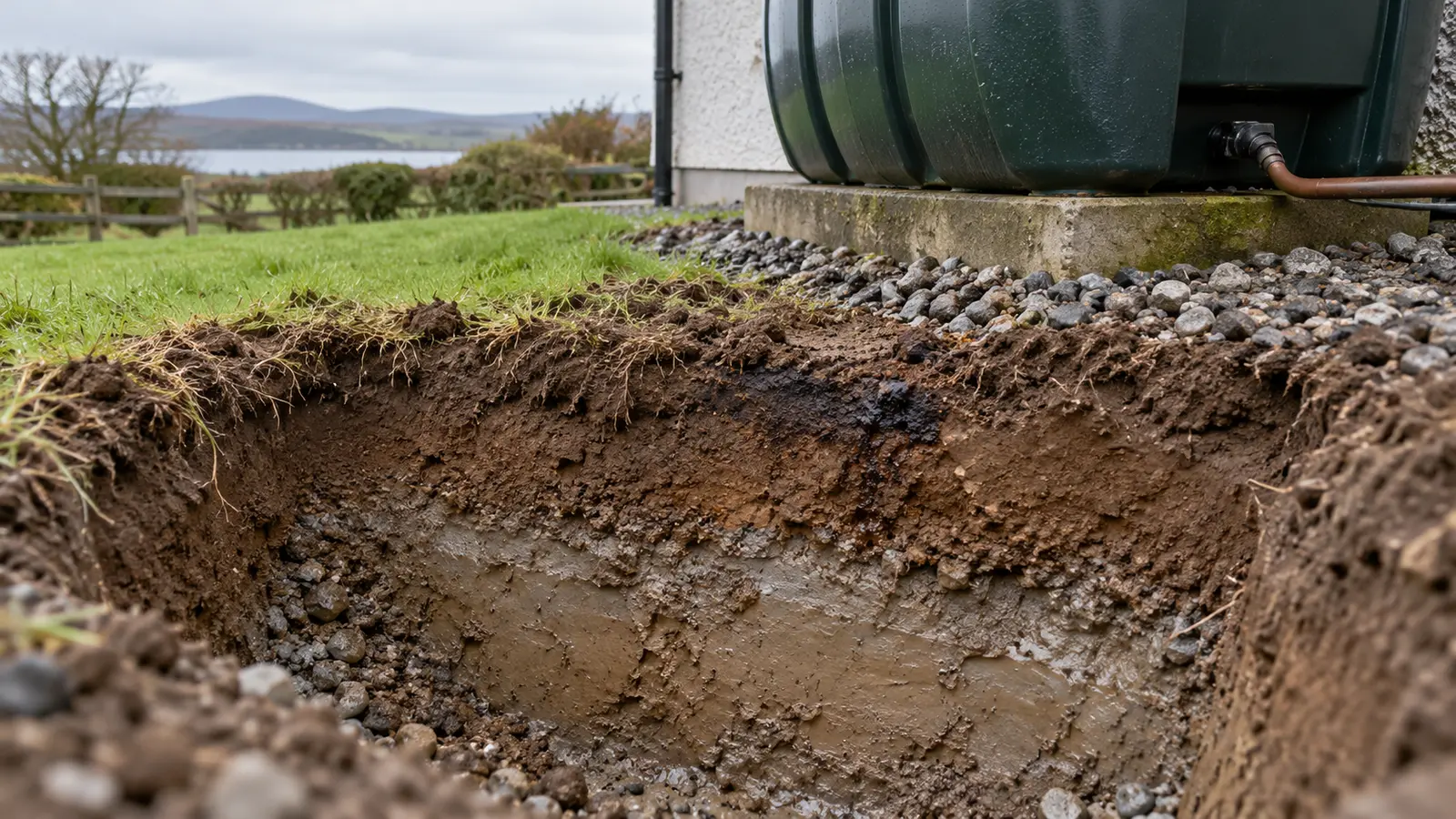
Heating oil does not form a neat underground puddle. Once it enters the ground, its movement is influenced by gravity, capillary forces, the properties and structure of the soil and geology, the amount of oil released, the degree of water saturation and any preferential pathways available to it.
The visible spill at the surface may therefore represent only a small part of the contamination below ground.
What controls the direction of movement?
Surface gradient
At the surface, oil will generally tend to move towards lower ground. Surface slope can therefore provide an initial indication of where a release may travel.
However, once oil enters the ground, the surface gradient becomes only one part of the picture.
Subsurface gradient
Layers beneath the ground may slope in a completely different direction from the surface.
For example, a relatively flat garden may overlie a sloping clay layer. Oil moving vertically through the upper soil can reach that lower-permeability clay and then begin travelling laterally along its surface.
Contamination can therefore migrate in a direction that would not be apparent simply by looking at the property above.
Permeability, pore structure and saturation
Oil distribution is governed by the connected pore space, permeability and capillary properties of the ground, as well as the quantity released and the water and air already occupying the pores. More-permeable materials and open pathways can permit faster movement, but the resulting pattern is rarely uniform.
Dense, fine-grained soils can substantially retard migration. Intact clay commonly has much lower permeability than sand, gravel or coarse fill, although fissures, roots, desiccation cracks, sand lenses and disturbed zones can create important pathways through an otherwise low-permeability layer.
Oil can enter or cross clay where sufficient pressure and pathways exist, but movement through intact clay is generally slower. Contamination may therefore spread laterally above a lower-permeability layer, while local defects or more-permeable inclusions may allow deeper migration.
By contrast, sands, gravels and coarse made ground can provide much easier routes.
Clean oversized hardcore, rubble or other material containing large interconnected voids can provide especially effective pathways, allowing oil to move much more freely than it would through compact natural soil.
Preferential pathways
Oil will also exploit easier routes through otherwise resistant ground.
These may include:
- service trenches and pipe runs;
- drains and ducts;
- old foundations;
- cracks and fissures;
- disturbed or poorly compacted ground;
- cavities and voids;
- coarse backfill; and
- other buried structures.
Rather than forcing its way uniformly through dense soil, oil may reach one of these pathways and then travel along it for a considerable distance.
Infiltration begins at the release point
When oil reaches unsealed ground, it begins moving into available pore spaces and following the easiest routes through the soil.
In simplified conceptual models of relatively uniform unsaturated ground, the affected zone may broaden as it moves downwards. This is only a starting model: the actual distribution depends on release conditions, soil layering, moisture and capillary behaviour.
In real sites, however, the ground is rarely uniform.
Stones, compacted layers, water-filled pores, foundations, service pipes, conduits, trenches and changes in soil type can all divert the oil away from this simple pattern.
Oil may move around dense material rather than through it, or reach a pipe trench, old foundation or other preferential pathway and travel along it.
Migration can continue below anything visible at the surface
Surface evidence can substantially underestimate the extent of contamination.
Damage to lawns and vegetation generally reflects contamination within the relatively shallow root zone. Oil can continue migrating well below this depth without producing corresponding visible damage above.
A spill may therefore have travelled considerably farther or deeper than the affected vegetation suggests.
This is particularly important where oil reaches a low-permeability clay layer and then travels laterally beneath apparently unaffected ground.
Deeper pathways can change the migration pattern again
Subsurface layers are rarely continuous.
Oil moving across clay may encounter an area where the clay becomes thinner, disappears or is interrupted by more permeable material. At that point, contamination may begin descending again into a deeper geological layer.
Where rock is relatively close to the surface, fractures, fissures and weathered zones can also provide pathways to greater depth.
Oil entering fractured rock may subsequently move in directions that are difficult to predict from surface observations alone.
A single spill can therefore occupy different pathways at different depths, making investigation considerably more complicated than simply identifying a stained area at the surface.
The composition of the oil changes as it travels
Heating oil contains many different hydrocarbon compounds.
As these compounds migrate through soil, they do not all behave in the same way. Some are more mobile, some volatilise more readily, some dissolve into water more easily, and others are more strongly retained by soil and organic matter.
The composition of the contamination can therefore change with distance and time.
This process can alter the odour of the oil. Contamination some distance from its source may not smell exactly like fresh heating oil and can sometimes produce solvent-like, polish-like or other petroleum-related odours.
For this reason, odour alone should not be used to identify the product, locate the source or define the extent of contamination.
Early migration can be rapid
Migration can be rapid soon after a release where sufficient oil enters coarse, permeable soil, gravel, hardcore, trenches or other open pathways.
Movement then tends to slow as the oil becomes distributed through the ground, encounters less-permeable materials, or becomes retained within finer soils and organic matter.
This makes early action important.
Stopping the release and, where appropriate, interrupting known migration pathways can reduce the opportunity for contamination to spread farther into the ground, towards buildings or towards water.
The pattern changes over time
Contamination does not remain chemically or physically unchanged.
Components may:
- evaporate;
- dissolve into water;
- biodegrade;
- become retained by soil and organic matter;
- migrate farther from the source; or
- remain as residual contamination within soil and fill.
The absence of fresh oil or a strong odour at a later stage does not therefore demonstrate that contamination has disappeared.
Time affects both the behaviour of the spill and the interpretation of subsequent investigation results.
Define the problem before setting the remedy
A remediation project should begin with an adequate understanding of the problem.
A good investigation considers:
- the source of the release;
- the likely quantity and duration;
- surface and subsurface gradients;
- soil and geological conditions;
- preferential pathways;
- the depth and lateral extent of contamination;
- buildings and underground services;
- groundwater and surface water;
- neighbouring property;
- other potential receptors; and
- the uncertainties that remain.
A superficial investigation cannot reliably establish what is happening at depth.
Likewise, uncontrolled excavation undertaken before the contamination has been adequately characterised can destroy useful evidence, damage services, spread contamination and produce unnecessary waste without necessarily addressing the real problem.
Professional judgement
In practice, it is rarely possible to prove the location of every trace of oil beneath a site.
The objective of investigation is therefore not to achieve impossible certainty. It is to develop a sufficiently reliable understanding of the source, pathways, extent and receptors to support defensible decisions about risk and remediation.
That requires investigation at a scale appropriate to the site.
Where contamination may have migrated to depth, travelled along geological interfaces, entered made ground or fractured rock, or followed buried structures, surface observations alone are inadequate.
You cannot design an effective remedy for a contamination problem that has not first been properly understood.
A thorough investigation does not eliminate every uncertainty, but it should identify the major contamination mass, the important migration pathways and the receptors that could be affected.
A spill is happening now?
Prioritise safety, stop the source only if it is safe to do so, take reasonable steps to prevent further spread, and follow the emergency guidance rather than relying on this explanatory article.
Read next
- How domestic heating-oil spills spread
- How heating oil can affect groundwater
- How an oil-spill site is assessed and remediated
- Understanding oil-spill sampling, laboratory results and monitoring
EDITORIAL INFORMATION
About this guide
Author: Spill-Response Editorial Team
Jurisdiction: Northern Ireland launch version. General technical explanations may also be relevant elsewhere, but reporting duties, official contacts and legal requirements must be checked for the applicable jurisdiction.
Last reviewed: 22 September 2026
Key sources consulted: Environment Agency – LCRM Stage 1 risk assessment; UKHSA – Kerosene: general information; NI Direct – Oil spills at home; and DAERA – Development on land potentially affected by contamination.
Review status: Final technical and source review completed for the Northern Ireland launch version.
Limitations: This guide provides general information and is not a substitute for site-specific environmental, legal, insurance or emergency advice.