
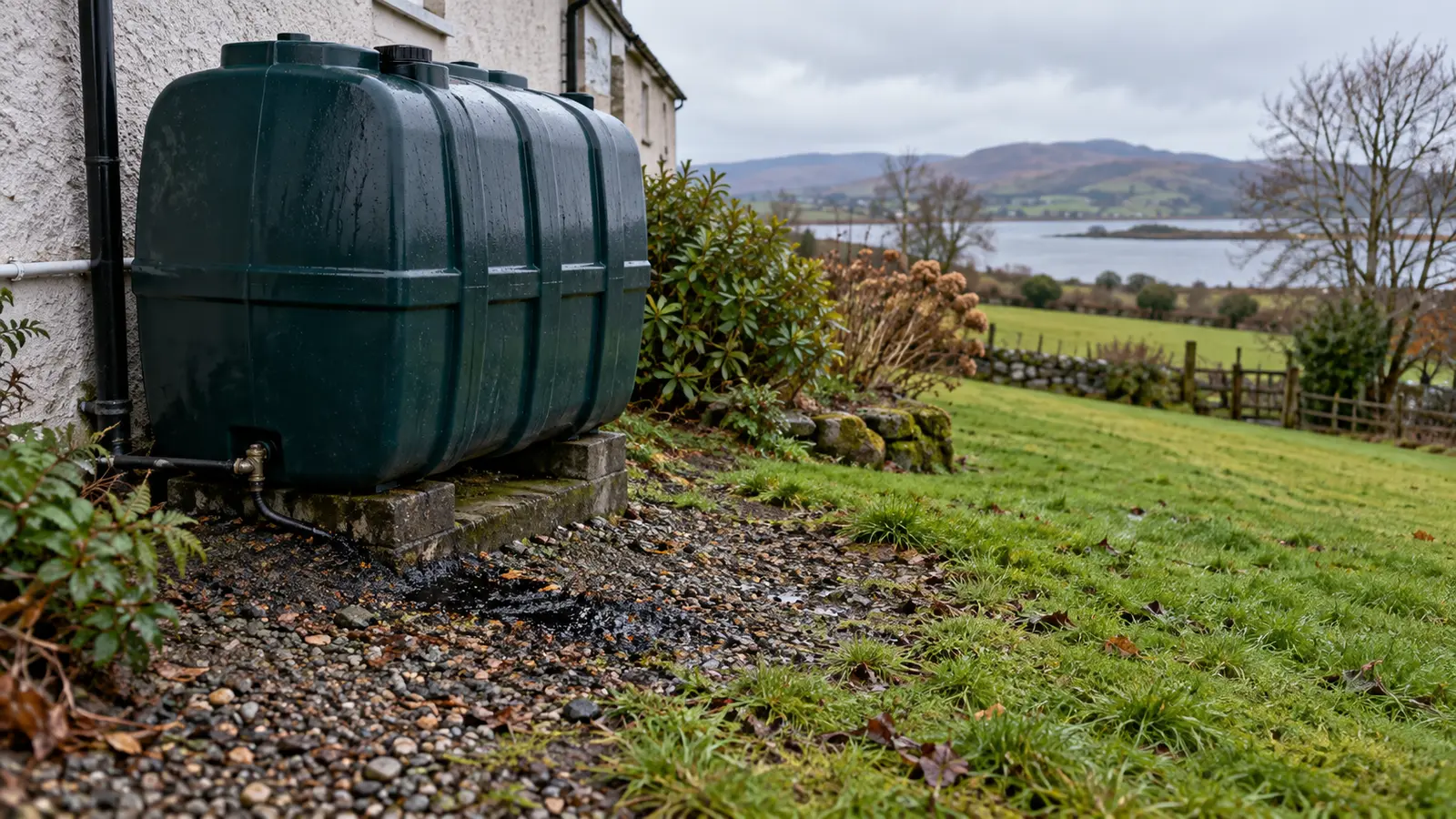

OIL SPILLS EXPLAINED
Heating oil rarely stays exactly where it is released. It can soak into soil, follow drainage and service routes, move beneath hard surfaces or buildings, and – in some circumstances – reach groundwater or surface water.
THE SHORT ANSWER
The direction and distance of travel depend on the volume released, the leak duration, ground conditions, slope, rainfall, drains, foundations and other pathways. A small visible stain does not always represent the full affected area, and odour alone cannot define the extent of contamination.
THE MAIN ROUTES
Oil follows pathways, not property boundaries
Several routes can operate at the same time. The most obvious route is not necessarily the most important one.
Through soil and made ground
Oil can infiltrate downwards and spread laterally through soil, disturbed ground, gravel, hardcore and backfill. Different soil layers may slow, redirect or concentrate movement.
Construction can create an important pathway towards a building. Foundation excavations are often backfilled with materials that are more permeable than the surrounding natural ground. Where this occurs beside relatively low-permeability soil such as clay, oil may preferentially follow the backfill or the interface between materials towards or around the foundations.
Coarse stone, hardcore and construction voids can allow oil to move more readily than it would through the surrounding fine-grained ground. They can also provide space in which contamination accumulates beside or beneath a building. The importance of this pathway depends on the actual construction, levels, ground conditions and location of the release; it should be investigated rather than assumed.
The exact construction and ground conditions vary between properties, but this is one reason why an external spill should not be assessed solely by its distance from the house or by what is visible at the surface.
Along drains and service trenches
Pipe trenches, ducts, land drains, sewers and utility routes can provide easier pathways than the surrounding ground and carry oil away from the release point.
These preferential pathways can allow contamination to travel in directions that would not necessarily be predicted from the surface slope alone.
Beneath hard surfaces and buildings
Concrete, paving and foundations may hide rather than prevent movement.
Concrete and paving may appear solid, but joints, cracks, penetrations and interfaces can allow oil to reach the materials below. The cementitious material itself may also absorb petroleum compounds. A visible surface stain may therefore show where oil was present without defining the contamination beneath or around the slab.
Once oil has passed through concrete or paving and entered permeable hardcore, fill or voids below, it may migrate laterally and vertically away from the visible stain. There may then be little or no surface evidence showing where the contamination has travelled.
Towards water and low points
Slope, rainfall, shallow groundwater, ditches, streams, wells and drainage outfalls can change both the direction of travel and the urgency of the response. Rainfall may increase surface runoff or infiltration and can alter how contamination is redistributed, but the effect is site-specific and should not be simplified to water merely pushing all of the oil in one direction.
Where oil reaches groundwater, a drain or another preferential pathway, impacts can occur well away from the original release point. At groundwater, some oil may remain as separate-phase product while more soluble constituents can dissolve and move with groundwater. These behaviours require different investigation and response methods.
A TYPICAL SEQUENCE
From release to a wider contamination problem
01 – Release
Oil escapes from a tank, pipe, boiler, fitting or during a delivery incident.
02 – Entry
The oil enters soil, stone, joints, drains, hardcore or building fabric.
03 – Migration
Gravity, ground conditions and easier pathways influence where it moves.
04 – Impact
Odours, staining, damaged vegetation, affected materials or risks to water, buildings and neighbouring property emerge.
05 – Persistence
Residual oil can remain in soil, fill or building materials after the original leak has been stopped.
WHAT CONTROLS THE SPREAD
Six factors that change every case
- Amount released and how long the leak continued
- Fuel type, temperature and weather conditions
- Soil, rock, made ground and groundwater depth
- Slope, foundations, drains and underground services
- Rainfall, water movement and nearby receptors
- Time elapsed before the source was stopped and assessed
Important: visible evidence is only part of the picture
The area of contamination visible at the surface may bear little resemblance to the extent of the oil below ground.
On lawns and other vegetated areas, a heating-oil spill may cause yellowing, browning or dieback of the grass, sometimes referred to informally as a “grass burn”. This provides useful evidence of where oil has affected the shallow root zone, but it does not show how far the oil has travelled beneath it.
Visible vegetation effects mainly reflect conditions in the shallow root zone. In sandy, gravelly or otherwise permeable ground, heating oil can move below that zone and continue through the underlying soil. There may then be little or no corresponding surface evidence to show where the oil has travelled.
Hard surfaces can be similarly misleading. A stain on concrete or paving can show where oil has been present at the surface, but once oil has penetrated through the material and entered permeable hardcore or fill beneath it, the contamination may continue to spread without producing a corresponding stain above.
Likewise, clean-looking soil at the surface does not by itself demonstrate that deeper ground is unaffected.
The visible stain, damaged vegetation or odour should therefore be treated as evidence that a spill has occurred – not as a reliable boundary of the contamination.
RECORD WHAT YOU KNOW
Useful early evidence
Record the discovery time, suspected source, tank level or delivery history, visible staining, odours, weather conditions, nearby drains, wells and watercourses, and any actions already taken.
Photograph affected areas where it is safe to do so. Retain delivery records, invoices, photographs, reports, correspondence and details of any work undertaken.
This information can become important when reconstructing when the release occurred, estimating its potential scale and understanding how the contamination may have moved.
SEEK SPECIALIST INPUT
When the pathway may be complex
Prompt professional assessment is particularly important where oil may have entered drains, reached water, moved beneath a building, crossed a property boundary, affected a private well, created significant indoor odours or continued leaking for an uncertain period.
Some sites also have ground conditions or a history that make it particularly difficult to predict where spilled oil may travel.
Previously developed or brownfield land
Extra care may be needed where a property has been constructed on previously developed or brownfield land – for example, the site of a former factory, works, depot or other industrial premises.
The ground beneath these developments may have been excavated, filled, reworked or altered several times before the houses were constructed. Made ground can contain different soils, rubble, hardcore, old foundations, drainage features, service trenches and other buried structures. There may also be contamination associated with the site’s previous use.
These conditions can make the movement of a new heating-oil spill considerably more difficult to predict. Buried structures and permeable materials may create pathways that would not exist in undisturbed natural ground, while pre-existing contamination can complicate the investigation of the new release.
Complex or highly variable geology
Natural ground conditions can also create complicated migration pathways.
Layers or lenses of sand, gravel, clay, silt and other materials can have very different permeabilities. Oil moving downwards may encounter a less-permeable layer and begin travelling laterally along it, while more permeable layers of sand or gravel can provide preferential pathways through which contamination moves more readily.
The resulting distribution of oil below ground may therefore be quite different from what would be predicted simply from the location of the release at the surface.
Where these conditions are present – particularly where buildings, groundwater, surface water, neighbouring property or other sensitive receptors could be affected – investigation should be undertaken by an appropriately experienced environmental professional. Depending on the circumstances, this may require expertise in contaminated land, hydrogeology and oil-spill investigation.
The objective is not simply to find contaminated soil. It is to understand where the oil has travelled, the pathways it may continue to follow and what it could affect next.
A spill is happening now?
Prioritise safety. Stop the source only if it is safe to do so, take reasonable steps to prevent further spread, and use the emergency guidance rather than relying on this explanatory article.
READ NEXT
Continue through the assessment journey
- Identify the fuel involved
- Understand how heating oil behaves in soil
- Learn how groundwater can be affected
- Check the risks to drains and surface water
- See how a spill site is assessed and remediated
EDITORIAL INFORMATION
About this guide
Author: Spill-Response Editorial Team
Jurisdiction: Northern Ireland launch version. General technical explanations may also be relevant elsewhere, but reporting duties, official contacts and legal requirements must be checked for the applicable jurisdiction.
Last reviewed: 22 September 2026
Key sources consulted: Environment Agency – LCRM: Before you start; Environment Agency – LCRM: Stage 1 risk assessment; NI Direct – Oil spills at home; DAERA – Development on land potentially affected by contamination; and UKHSA – Kerosene: general information.
Review status: Final technical and source review completed for the Northern Ireland launch version.
Limitations: This guide provides general information and is not a substitute for site-specific environmental, legal, insurance or emergency advice.