
How are oil-spill cleanup targets decided?
The short answer
Cleanup targets should follow the incident, the affected materials, the relevant pathways and receptors, and the framework under which the work is being undertaken. They should be defined and justified by competent professionals, with appropriate regulatory involvement where relevant. A generic screening value, waste-classification result or percentage reduction is not a universal clearance certificate. Ask for the objectives, criteria, verification plan and remaining uncertainties in writing before the work is treated as complete.
A homeowner may be told that the soil is “below the limit”. A useful cleanup target explains what must be achieved at the actual property, how that outcome will be checked and what happens if the evidence does not support completion. Aiming for zero residual oil is unachievable and unprovable, especially when it is very unlikely there were Xero hydrocarbons present before the spill.
By Spill-Response Editorial Team · Sources checked: 26 October 2026 · Northern Ireland focus
In this guide
- Start with the decision the target is meant to support
- Clarify whether the work concerns a new incident
- Check the investigation behind the criteria
- Understand what a reported number represents
- Keep four different kinds of criteria separate
- Agree verification before the critical work is finished
- Ask who is making each decision
- Read the final conclusion alongside its limitations
- Your practical checklist
- Your next step
- Sources and further reading
Start with the decision the target is meant to support
Ask what “clean” means in the proposed scope. Is the team deciding whether to remove more soil, whether a room can be occupied, whether a water concern has been resolved or whether the overall project can close? Different decisions may require different evidence and may be reached at different times.
An objective describes the intended outcome. A criterion describes how a particular aspect will be judged. A verification plan explains how the required evidence will be collected. Keeping these ideas separate makes a report easier to read and makes it harder for a convenient test result to replace the original purpose of the work.
Write down the decisions that matter to you: returning to a room, using the garden normally, restoring a water supply or completing reinstatement. Ask the lead specialist to show where each is addressed. Do not assume a single soil table answers every household concern.
Clarify whether the work concerns a new incident
LCRM distinguishes recent pollution incidents from historical land-contamination assessment. [1] Ask the consultant which parts of the framework apply to your case and how that affects the proposed response. This is especially useful if a report discusses redevelopment screening while your concern is a recent tank leak at an occupied home.
An assessment can support a decision about what remains, but the explanation should address the incident and the work already undertaken. Ask what practical removal or treatment was considered, what was achieved and why any residual material is proposed to remain. Record any relevant regulator’s involvement accurately rather than paraphrasing a conversation as formal approval.
Avoid two opposite assumptions: that any detectable residue always demands unlimited excavation, or that passing one screening comparison automatically resolves a new spill. The professional’s job is to explain the appropriate endpoint and its basis. The homeowner should receive a usable account of that reasoning.
Check the investigation behind the criteria
The LCRM risk-assessment stage uses an evolving conceptual site model to connect the evidence with relevant pollutant linkages. [2] In practical terms, the team should understand where contamination is suspected, how it could affect people or the environment, and which uncertainties remain important.
Ask how the investigation represents the affected area. Were locations chosen to test the suspected routes? Were difficult areas assessed? Are depths, sample positions and dates clear? If an important area was inaccessible, ask what that means for the conclusion rather than accepting a map with no explanation of its blank spaces.
A target cannot repair a poor evidence base. If the extent remains uncertain, the immediate need may be further investigation or a carefully stated limitation. Ask the specialist to distinguish a confirmed boundary from an assumed one and explain what observation would require the plan to change.
Understand what a reported number represents
A laboratory result needs an analyte or analytical grouping, a unit, a method and a sample reference. “Oil level” is too vague to assess without those details. Ask which parts of the fuel-related analysis are relevant to the decision and why the chosen suite is suitable.
Check that a comparison uses compatible units and the appropriate basis. Soil, water and air results cannot be placed against one another merely because they all relate to the same spill. Ask the assessor to explain conversions, assumptions and limitations in the report instead of leaving the homeowner to infer them.
A percentage reduction describes change relative to a starting point. It does not, by itself, tell you whether the remaining condition meets the objective. Ask for both the starting and ending evidence, the method of comparison and the relevance of the remaining concentration or condition. This is particularly important when impressive treatment claims appear without a site-specific explanation.
Keep four different kinds of criteria separate
| Kind of decision | What to clarify |
|---|---|
| Screening assessment | What question does the comparison screen, and what follows from it? |
| Remediation completion | Which agreed objectives and criteria must be demonstrated? |
| Waste classification | How must excavated material be classified and managed? |
| Facility acceptance | Will the chosen receiving facility accept that particular waste? |
DAERA publishes the Northern Ireland version of WM3 for waste classification. [3] That framework concerns the classification of waste; a waste assessment is not a decision that soil left beneath a home is suitable for its use. Equally, a site’s remediation criterion does not automatically determine a receiving facility’s acceptance requirements.
Ask the team to label documents by purpose. A laboratory certificate can contribute to more than one assessment, but each conclusion needs its own reasoning. If the only evidence offered for completion is a disposal document, request the separate assessment of what remains at the property.
Agree verification before the critical work is finished
LCRM’s remediation stage calls for a verification plan as part of the strategy, followed by a report demonstrating the work’s outcome. [4] This supports a practical question early in the job: what will be recorded while the relevant ground, structure or installation is still accessible?
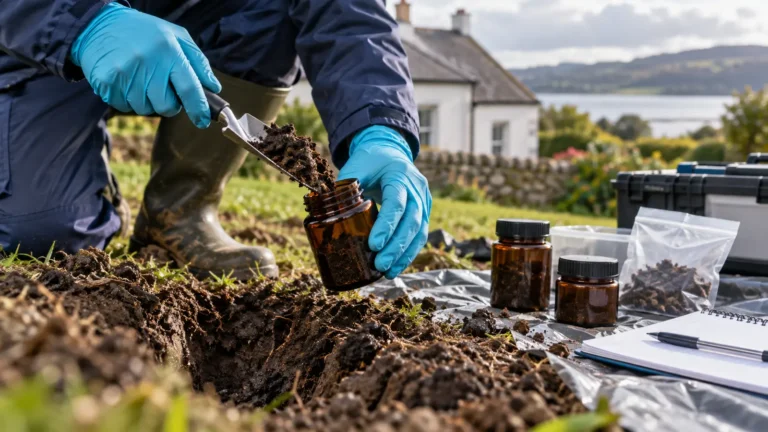
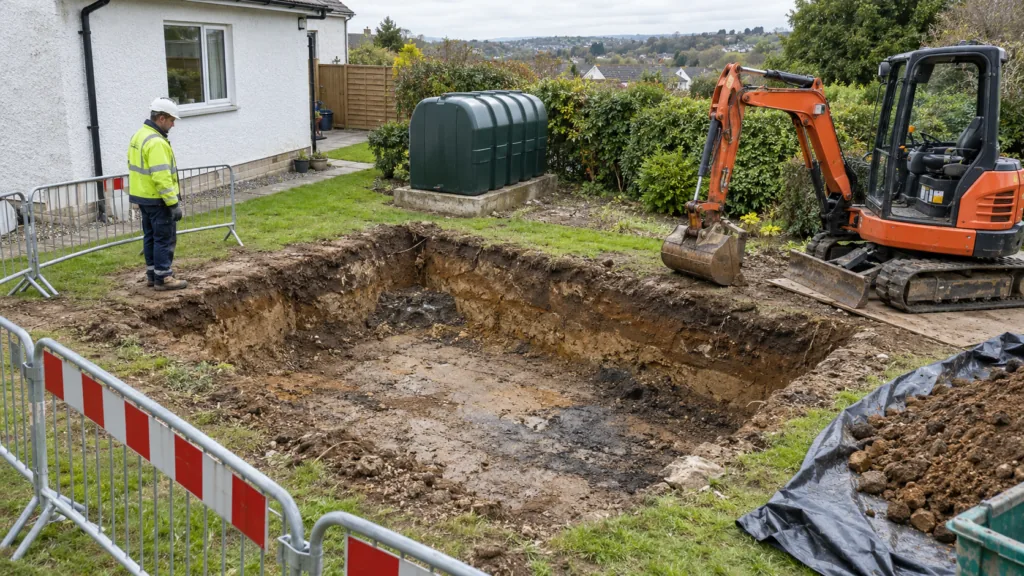
Ask which inspections, observations and samples are planned, where they will be taken and who will decide whether more work is needed. Identify any hold point before backfilling, replacing a floor or removing temporary equipment. The plan should explain what happens if results do not support the proposed next step.
Also ask how changes will be recorded. A revised excavation area, unexpected service trench or different treatment method may affect the evidence required. A verification plan should follow the actual work, with reasons for changes, rather than becoming an unchanged document attached to a substantially different project.
Ask who is making each decision
A contractor may complete an activity, a consultant may interpret the evidence, an authority may address matters within its remit, and an insurer may agree payment. Ask which person is responsible for the completion recommendation and which decisions require input from others.
Do not assume that an insurer’s payment authorisation is environmental approval. Do not assume that an authority’s involvement covers every private contractual or building issue. Request the scope of each statement. This is especially important when an email says simply that somebody is “happy” without identifying what they reviewed.
If there is disagreement, ask whether it concerns the investigation, the criteria, the interpretation or the proposed work. That distinction helps identify the next useful action. Another laboratory test will not necessarily resolve a disagreement about which decision the parties are trying to make.
Read the final conclusion alongside its limitations
The report should say what was achieved and what remains conditional. Ask about inaccessible areas, ongoing controls, monitoring, maintenance or restrictions on future use. Where further checks are proposed, obtain a named responsible party, a timetable or trigger, and an explanation of what action follows an unsatisfactory result.
A conclusion for current residential use should not be casually extended to every future alteration. If you later excavate, change drainage or convert part of the property, tell the relevant professional about the previous spill and provide the report. This is a practical reason to keep the records, not a prediction that future work will be prevented.
A useful hypothetical example is a project with satisfactory soil verification but a water-pipe issue still open. The soil result may support one milestone while the overall incident remains unresolved. Ask for a list of closed and outstanding decisions so that “completion” does not hide this distinction.
Your practical checklist
- Identify the decision each proposed target supports.
- Confirm the framework for the recent incident and the property use.
- Check the investigation and its limitations.
- Ask for compatible units, methods and a clear comparison basis.
- Keep remediation, waste and facility-acceptance decisions separate.
- Agree verification and hold points before reinstatement.
- Retain the conclusion and any follow-up obligations.
Your next step
Ask for a one-page explanation linking the objectives, criteria and proposed verification. Read our guides to checking cleanup completion, sampling and laboratory results and interpreting removal percentages.
Related homeowner guides
- Where does oil-contaminated soil go, and how is the waste classified?
- How will my home and garden be restored after an oil-spill cleanup?
Sources and further reading
- Environment Agency — LCRM: before you start. Framework, recent incidents and territorial context.
- Environment Agency — LCRM: Stage 1, risk assessment. Conceptual understanding and assessment evidence.
- DAERA — Waste classification: technical guidance. WM3 for Northern Ireland waste classification.
- Environment Agency — LCRM: Stage 3, remediation and verification. Verification planning and reporting.
Sources checked 26 October 2026. This article explains questions to ask; it sets no numerical cleanup standard and cannot approve a site’s completion.
Need help with your situation?
If you need help identifying suitable specialist support, tell us what you have observed and the questions you need answered.