

Can I stay in my home during an oil-spill cleanup?
The short answer
Some projects may allow continued occupation, while others require temporary restrictions or a move elsewhere. The decision needs a property-specific assessment and clear advice from the appropriate professionals. Do not treat a contractor's presence, an insurer's accommodation decision or one instrument reading as automatic confirmation that the home is suitable to occupy. Ask which areas can be used, what precautions apply, when the advice will be reviewed and what evidence is required before returning to normal use.
Whether a household can remain at home during an oil-spill cleanup is an immediate, practical concern. The answer involves more than the strength of a smell. It must consider the contamination, the proposed work, essential services, safe access and the needs of the people living there.
By Spill-Response Editorial Team · Sources checked: 26 October 2026 · Northern Ireland focus
In this guide
- Address an immediate concern first
- Separate the questions that determine occupation
- Explain the household's needs
- Consider the work as well as the spill
- Ask what air-testing results actually support
- Get clear instructions for staying at home
- Clarify temporary accommodation and funding
- Agree the conditions for returning
- Resolve conflicting advice explicitly
- Your practical checklist
- Your next step
- Sources and further reading
Address an immediate concern first
If fumes or symptoms are causing concern, seek prompt advice rather than waiting for the next scheduled visit. Northern Ireland's domestic-spill guidance advises contacting the council's environmental health department about a strong indoor oil smell. [1] For an immediate emergency, use the emergency services.
UKHSA advises people who have inhaled kerosene to move away from the source and seek medical advice. [2] Do not deliberately remain in an affected room to see whether symptoms recur or ask another household member to test it by smell. Explain suspected heating-oil exposure when speaking to a clinician.
Tell the incident manager what has changed and where it is occurring. Record observations from a safe position, including the time and any advice received. A household should not have to wait for the insurance position to be settled before raising an urgent health or environmental concern.
Separate the questions that determine occupation
An assessment should consider several issues together. Are affected materials or vapours relevant to occupied rooms? Is the water supply suitable for the intended uses? Can people safely enter and leave? Are heating, electricity, sanitation and other essential facilities available? Will the work create additional restrictions?
Ask who is responsible for each question. An environmental specialist, building professional, water supplier and contractor may each address a different part. A coordinator should bring those findings into a clear instruction for the household rather than leaving you to combine separate technical opinions yourself.
Make the scope explicit. Advice about sleeping in an unaffected room does not necessarily cover using a nearby kitchen or crossing a work area. Likewise, advice that the building is structurally usable does not answer an unresolved water-quality concern. Ask what has actually been assessed.
Explain the household's needs
Tell the relevant professional about children, pregnancy, health conditions, disability or other circumstances that may affect the assessment or practical arrangements. Share sensitive details directly and privately with the person who needs them. The public article does not need to classify every household into a generic risk category.
Explain ordinary routines: which rooms are used for sleeping, working, food preparation and care. Include visitors or carers where relevant. An occupation plan that assumes a room is rarely used may not fit a household where somebody spends most of the day there.
Also discuss pets, mobility, medication storage and access needs when planning temporary arrangements. These details can matter even where the environmental assessment is straightforward. A theoretically available route is of little use if an occupant cannot physically use it.
Consider the work as well as the spill
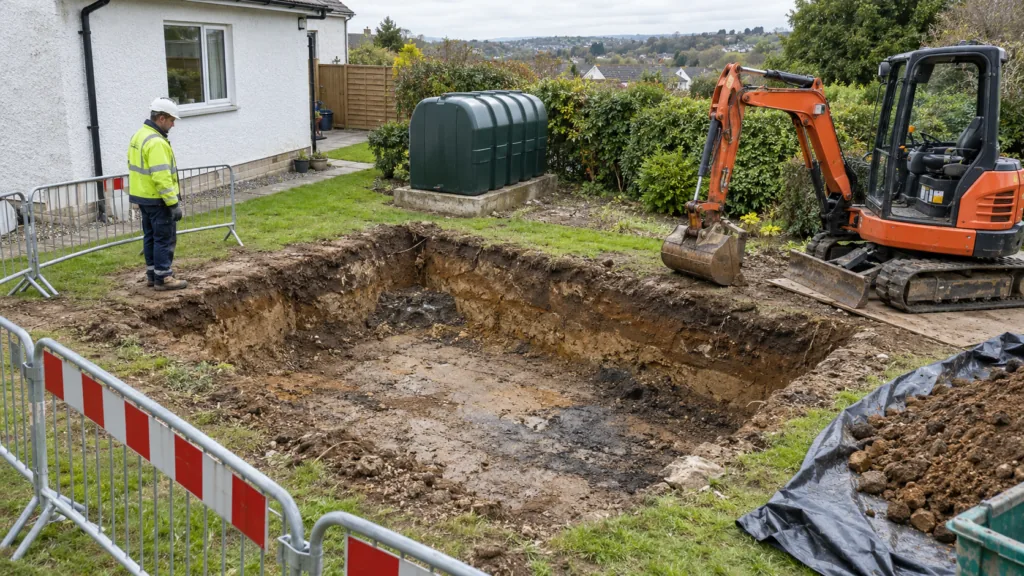
Excavation, machinery, open floors, temporary barriers and service interruptions can affect whether occupation is practical. Ask the contractor for the arrangements that keep occupants separate from work and explain any periods when access or facilities will be unavailable.
HSENI's excavation example includes site access, vehicle routes, services and communication of the working method. [3] It illustrates why a worksite needs planned controls. It does not provide a blanket permission for residents to remain beside any excavation or a method that can be copied without assessment.
Ask whether the position changes during particular activities. A home may be usable during one stage and unsuitable during another. The programme should identify those stages early enough for the household to make arrangements, with a process for unexpected changes.
Ask what air-testing results actually support
If air testing is used, request a plain-English explanation of its purpose, locations, timing and findings. Ask whether the conditions during testing represent the proposed pattern of occupation. A result obtained with temporary equipment operating should be interpreted in that context.
Do not reduce the decision to whether a handheld reading is “low”. Ask what the instrument measured and what other evidence was considered. Similarly, a change in smell is useful information but does not automatically describe the condition of every room or the remaining source.
The written advice should say whether occupation relies on controls, which controls must remain and who checks them. Do not turn off equipment, remove barriers or close ventilation arrangements to experiment. If controls are impractical for the household, explain that so the professional can review the plan.
Get clear instructions for staying at home
| Issue | What the household needs to know |
|---|---|
| Rooms and routes | Which areas may be used and which must be avoided? |
| Essential services | What is available, restricted or temporarily replaced? |
| Work activity | When will access, noise or facilities change? |
| Controls | What must remain in place and who checks it? |
| Changes | Which observations require an immediate call? |
| Review | Who reassesses occupation and when? |
Ask for instructions that every occupant can understand. A technical report may contain the evidence, but the daily rules should be easy to find. Include a named contact and an out-of-hours arrangement appropriate to the project; do not assume the contractor answers at all times.
Review the arrangement if circumstances change. New fumes, a loss of essential services, an expanded excavation or different household needs may require a fresh decision. Previous advice should not be treated as permanent approval regardless of later conditions.
Clarify temporary accommodation and funding
If temporary accommodation is advised, ask the insurer whether the relevant policy benefit applies, what it covers and how approval works. Obtain the amount or limit, duration basis, review arrangements and treatment of associated costs. Do not assume that an environmental recommendation automatically establishes insurance entitlement.
The Financial Ombudsman Service's home-insurance guidance explains that settlement depends on policy wording and circumstances. [4] The useful practical step is to obtain the insurer's position in writing and identify what evidence it needs about occupation. A general promise to discuss costs later can leave uncertainty when bookings must be made.
Tell the claims handler about the household's practical needs and ask what options are available. If you make arrangements yourself, clarify funding before committing where circumstances allow. Keep receipts and records, and distinguish an urgent initial arrangement from a longer booking that may need separate approval.
Agree the conditions for returning
Ask what must be demonstrated before returning home or reopening a restricted area. The decision may involve environmental findings, essential services, building conditions and worksite arrangements. Request a coordinated answer identifying any remaining limits rather than relying on one party's informal reassurance.
A return does not necessarily mean every cosmetic task is complete. Conversely, finished decoration does not prove that an unresolved environmental issue has been addressed. Ask which milestones have been achieved and which work can safely continue after occupation resumes.
Confirm whether temporary equipment or monitoring remains, who maintains it and what access is required. If there are follow-up tests, ask what decision they support and what would happen if the result is unsatisfactory. Keep this information with the final cleanup records.
Resolve conflicting advice explicitly
If two people give different answers, ask them to state the evidence, scope and assumptions behind each position. One may be addressing a particular room, another the whole property; one may be considering present controls, another normal conditions after their removal.
Request a written reconciliation through the lead contact, with the appropriate professional input. The homeowner should not be expected to choose a technical conclusion by comparing job titles or confidence. If a material concern remains unresolved, make that clear and seek advice on the interim arrangement.
As a hypothetical example, a household could be able to use the living area while a service interruption makes overnight occupation impractical. Another property might have working services but an unresolved indoor-air concern. These examples show why a single question about smell cannot decide the whole issue.
Your practical checklist
- Raise urgent symptoms or strong indoor fumes promptly.
- Identify who is coordinating the occupation assessment.
- Explain household needs and ordinary room use.
- Obtain clear instructions on areas, services and controls.
- Confirm accommodation funding and review dates separately.
- Request written return conditions and any continuing restrictions.
Your next step
Ask for a plain-English occupation plan linked to the current stage of work. Read our guides to health concerns, sampling and monitoring and checking cleanup completion.
Related homeowner guides
Sources and further reading
- nidirect — Oil spills at home. Northern Ireland guidance on domestic incidents and indoor smells.
- UKHSA — Kerosene: general information. Exposure and medical-advice background.
- HSENI — Example method statement for excavations. Northern Ireland worksite planning example.
- Financial Ombudsman Service — Settling home insurance claims. UK settlement guidance; individual policy terms apply.
Sources checked 26 October 2026. This article cannot determine whether a particular home is suitable for occupation or replace medical or site-specific professional advice.
Need help with your situation?
If you need help identifying suitable specialist support, tell us what you have observed and the questions you need answered.