

TANKS AND HEATING SYSTEMS
Domestic heating-oil spills can originate from many different parts of the system.
The most useful way to investigate a suspected loss is to follow the complete fuel route:
tank -> outlet fittings -> filter and valves -> supply pipe -> boiler fittings -> flexible hose -> burner
The first visible stain is not necessarily the source.
Oil may track along pipework, fittings, supports or building surfaces before reaching the ground, so the actual point of failure may be some distance from where contamination is first noticed.
Mechanical joints deserve particular attention
In practice, many heating-oil leaks occur at places where separate components have been joined together.
That does not mean the original installation was necessarily defective. It means that valves, compression fittings, seals, connectors and flexible hoses are mechanical components that can deteriorate, loosen or become damaged over time.
They can be affected by:
- ageing;
- vibration;
- temperature changes;
- freeze-thaw conditions;
- corrosion or oxidation;
- accidental impact;
- ground or structural movement; and
- previous maintenance or disturbance.
For this reason, fittings and joints are among the first places that should be inspected when a leak is suspected.
Start at the tank outlet
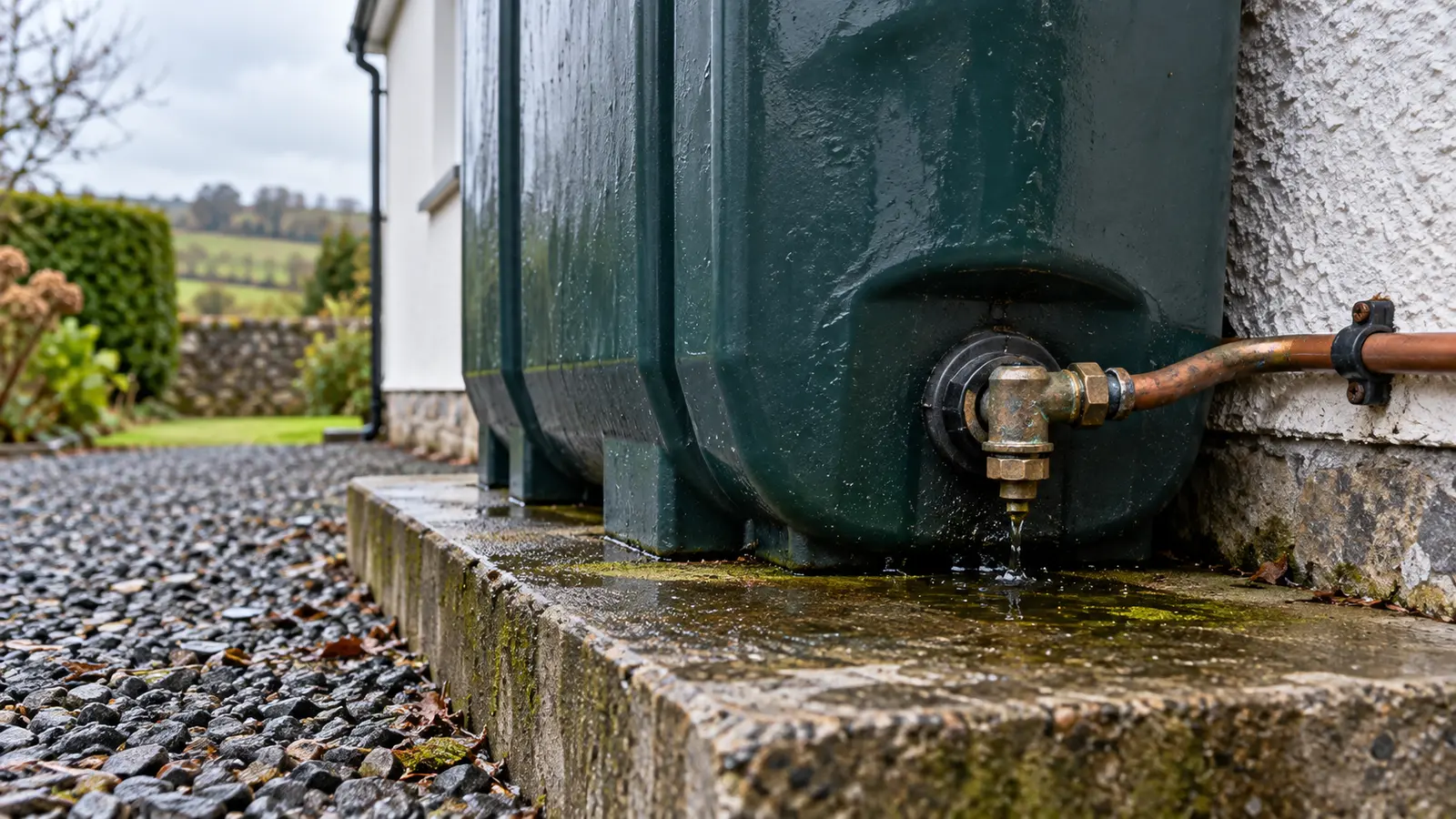
The connection where fuel leaves the tank is an obvious potential failure point.
Depending on the installation, the outlet assembly may include several fittings, valves or connectors before the supply pipe leaves the tank area.
Even a relatively small leak here can continue unnoticed for a long period and ultimately release a significant quantity of oil.
The inspection should look for:
- wet or stained fittings;
- deteriorated seals;
- loose connections;
- damaged valves;
- corrosion;
- impact damage; and
- evidence that oil has tracked along the pipe or tank rather than dripping directly beneath the failure.
Flexible hoses near the boiler
One particularly important component is the flexible fuel hose, often a braided metal hose connecting the fixed oil supply to the burner.
Flexible hoses are consumable components rather than permanent pipework.
They are exposed to heat, vibration and repeated boiler operation and can deteriorate internally or externally with age.
They should therefore be inspected during servicing and replaced in accordance with the manufacturer’s specified service life and the advice of a competent heating technician.
A failed flexible hose can release oil rapidly into a boiler house, utility area or other enclosed space.
Because the spill may occur indoors, the consequences can include contamination of floors and walls as well as significant petroleum odours within the building.
Filters can also leak
The fuel filter removes particulate material and, depending on the type of system, may also help separate water or debris before the fuel reaches the burner.
Potential leak points include:
- the filter housing;
- seals;
- inlet and outlet connections; and
- valves associated with the assembly.
A small leak can be difficult to notice, particularly where the filter is outside, concealed or rarely inspected.
Fire valves
Domestic oil-heating systems commonly incorporate a fire safety valve designed to shut off the fuel supply when excessive heat associated with a fire is detected.
The valve and its associated fittings introduce additional mechanical connections into the fuel line.
These joints can themselves become potential leak points and should be included in any systematic inspection.
De-aerators and Tigerloop-type systems
Some installations use a fuel de-aerator, commonly known by trade names such as a Tigerloop.
These systems help remove air from the fuel supply and can assist where the burner arrangement would otherwise make reliable fuel delivery difficult.
The unit itself and its associated pipework contain several connections.
Leaks can therefore occur at:
- mechanical joints;
- inlet and outlet fittings;
- flexible hoses; or
- the unit itself.
Where a de-aerator is installed, it should form part of the inspection rather than concentrating only on the tank and boiler.
Boiler and burner faults
Leaks can also occur within the boiler or burner assembly.
Most faults are relatively straightforward for a competent heating technician to diagnose, but occasional component failures can allow fuel to continue entering the burner or boiler when it should not.
This can result in oil accumulating inside the appliance and eventually escaping onto the surrounding floor.
These faults are less common than failures of hoses, fittings or pipework, but they demonstrate why repairing the tank alone does not necessarily identify the cause of every oil spill.
The appliance should be examined by a competent oil-heating technician where an internal boiler or burner failure is suspected.
Underground supply pipes
Buried fuel lines are particularly important because they can leak for a considerable period without creating obvious evidence at the surface.
Domestic systems commonly use small-diameter copper fuel pipe protected by an external coating or sleeve.
Potential causes of failure include:
- corrosion or oxidation;
- mechanical damage;
- ground movement;
- damage during gardening or construction;
- deterioration of protective coverings; and
- failed joints.
Where possible, buried supply pipework should form a continuous run rather than containing inaccessible underground joints.
Where joints are unavoidable, good practice is to keep them accessible for inspection – for example within a suitable inspection chamber – rather than permanently burying them.
A leak in a buried pipe can create a substantial contamination problem because the oil may enter the ground directly and continue unnoticed until fuel consumption, odour or boiler performance draws attention to it.
Tank failures
The tank itself can also fail.
Older plastic heating-oil tanks may become increasingly brittle with age and environmental exposure. Cracking, splitting, deformation or damage can eventually result in leakage.
A crack below the oil level can release a substantial quantity of fuel.
Tank condition should therefore be assessed together with:
- age;
- material;
- physical distortion;
- UV and weather exposure;
- base condition;
- support;
- outlet condition; and
- evidence of previous damage.
Steel tanks present different failure mechanisms, particularly corrosion, and should be assessed accordingly.
Sight gauges
Some tanks use an external sight gauge to indicate fuel level.
Damage or detachment of the gauge or its associated pipework can create a direct route for oil to escape.
Where the system incorporates a shut-off or safety mechanism, it should also be checked to confirm that it operates correctly.
A damaged sight gauge may appear minor but, because it is connected directly to the contents of the tank, it can potentially release a significant volume of oil.
Delivery incidents and overfilling
Spills can also occur during fuel delivery.
Potential incidents include:
- overfilling;
- failure of a tank or fitting during filling;
- leakage from delivery connections;
- incorrect filling arrangements; or
- fuel being discharged outside the intended system.
Delivery records can be particularly useful when reconstructing these incidents.
Note:
- delivery date and time;
- quantity supplied;
- tank level before and after delivery;
- when staining or odour was first observed;
- photographs;
- CCTV where available; and
- communications with the supplier.
Where responsibility for a delivery spill is disputed, evidence collected at or near the time of the incident can become very important.
Investigating the source of a suspected leak
Where the source is not immediately obvious, the system should be checked methodically from the tank towards the boiler.
Start with the tank
Inspect the tank itself carefully for signs of damage or leakage.
Look for:
- cracking, splitting, corrosion or deformation;
- staining or wetness on the tank surface;
- oil collecting on or around the tank base;
- deterioration around the outlet;
- leaking valves or fittings;
- problems with the sight gauge; and
- evidence that the tank or its supports have moved.
Good lighting is important because small leaks can be difficult to identify.
The tank base and support should also be examined. Oil collecting beneath the tank may indicate a leak higher up that has tracked down the tank wall rather than a failure at the base itself.
Check the fittings
Follow the fuel route away from the tank and examine every accessible mechanical connection.
These include:
- tank outlet fittings;
- isolation valves;
- filters;
- gauges;
- fire valves;
- connectors; and
- any accessible joints.
Even very small leaks can leave staining, wetness or a persistent petroleum odour.
Consider the buried supply pipe
Much of the fuel line may be underground and impossible to inspect visually.
Where the pipe enters or leaves the ground, check carefully for evidence of oil.
If the fuel line runs inside a larger protective conduit or duct, any oil appearing from the end of that conduit can be an important warning sign that the concealed pipe may be leaking.
However, the absence of visible oil at either end does not prove that the buried pipe is sound.
Inspect the boiler end
The boiler, burner, flexible hose, filter, valves and other fittings should also be checked.
A leak within the boiler house will often leave staining or oil on the floor, although oil can sometimes travel along components before becoming visible.
Where no obvious source can be found, a competent heating technician should investigate further.
Pressure-testing a concealed fuel line
Where the buried oil supply pipe is suspected but cannot be inspected directly, an appropriately competent heating technician can carry out a pressure or integrity test.
The line is isolated from the tank and appliance, pressurised using appropriate test equipment, and then monitored to determine whether the pressure remains stable.
A loss of pressure may indicate leakage from the pipework or one of its connections.
The exact test pressure, test duration, isolation method and acceptance criteria should be selected by the competent technician in accordance with the pipe material, installation, manufacturer requirements and applicable industry guidance.
Maintenance records can become important evidence
Regular servicing is valuable not only for keeping the heating system operating properly but also for creating a record of its condition.
During routine servicing, the householder should ask the heating technician to inspect the accessible parts of the fuel-storage and supply system, including where appropriate:
- the tank;
- tank supports and base;
- outlets and valves;
- filters;
- accessible supply pipework;
- flexible hoses;
- fire-safety devices; and
- boiler and burner connections.
Any defects identified should be recorded and corrected as appropriate.
The property owner should keep:
- annual service records;
- invoices;
- inspection records;
- details of repairs;
- replacement dates for components;
- tank inspection documentation;
- fuel-delivery records; and
- any relevant competent-person or OFTEC documentation.
Keeping these records together provides a useful history of the system.
If a spill later occurs, they may help establish:
- how the installation had been maintained;
- what condition was previously recorded;
- which components had been replaced;
- whether a defect was known; and
- when a failure may have developed.
Keep the records accessible
A simple dedicated folder – paper or digital – is sufficient.
The important point is that the documents can be produced quickly if they are needed by an:
- insurer;
- environmental consultant;
- heating engineer;
- regulator; or
- other party investigating the incident.
Good maintenance records do not prevent every failure, but they can provide valuable evidence of the condition and maintenance history of the system.
Warning signs householders should not ignore
A heating-oil leak is not always dramatic.
Possible warning signs include:
- unexplained increases in fuel consumption;
- a tank level falling faster than expected;
- persistent petroleum odour;
- staining around fittings or filters;
- oil beneath the boiler;
- vegetation dying along the route of a buried fuel line;
- unexplained damp or oily patches;
- repeated burner or fuel-supply problems; and
- petroleum odour indoors without an obvious visible spill.
A small persistent leak can ultimately release more oil than a short, obvious incident.
Finding the fault and assessing the spill are different jobs
Once a release is identified, two separate questions need to be answered.
1. Why did the heating system fail?
A competent oil-heating technician, tank specialist or other appropriately qualified contractor may be needed to identify and repair the mechanical fault.
2. Where did the released oil go?
An environmental consultant or spill-response specialist may then need to establish:
- how much oil escaped;
- how long the leak continued;
- where the contamination migrated;
- what receptors could be affected; and
- whether remediation is required.
Repairing the leaking component stops the source. It does not necessarily resolve the contamination that has already escaped.
A spill is happening now?
Prioritise safety. Stop the source only if it is safe to do so, protect drains and other receptors, and obtain competent heating and environmental assistance where required.
Read next
- How domestic heating-oil spills spread
- Heating oil, kerosene and gas oil: what is the difference?
- Who may need to be notified after an oil spill?
- Understanding insurance roles after an oil spill
EDITORIAL INFORMATION
About this guide
Author: Spill-Response Editorial Team
Jurisdiction: Northern Ireland launch version. General technical explanations may also be relevant elsewhere, but reporting duties, official contacts and legal requirements must be checked for the applicable jurisdiction.
Last reviewed: 21 September 2026
Key Northern Ireland sources consulted: NI Direct – Check your oil tank; NI Direct – Oil spills at home; and DAERA/NIEA – Check your heating oil tank regularly.
Review status: Final technical and Northern Ireland source review completed.
Limitations: This guide provides general information and is not a substitute for site-specific environmental, legal, insurance or emergency advice.