

TESTING AND MONITORING
A laboratory result is one piece of evidence.
Its meaning depends on why the sample was taken, where it was collected, how it was handled, what it was analysed for and how the result relates to the conceptual site model.
Good sampling is designed around a decision. More samples do not automatically produce a better answer, and a result without location, depth, method and context can be misleading.
Sampling should have a purpose
Every sample should help answer a defined question.
That question might be:
- Is contamination present?
- How far does the affected area extend?
- How deep has the oil migrated?
- Has groundwater been affected?
- Is contamination migrating towards a building or neighbouring property?
- Has remediation achieved its objective?
- Is the site improving or deteriorating over time?
The sampling strategy should therefore be linked directly to the conceptual site model and the decisions that need to be made.
Sample locations should answer a question
Samples should not be collected simply because a location is convenient or because a fixed number of samples is expected.
Each sample should be taken from a location and depth that adds useful information.
For example, a sample may be intended to:
- confirm contamination at the suspected source;
- define the lateral edge of a plume;
- establish the vertical depth of contamination;
- assess a potential pathway to groundwater;
- investigate possible migration beneath a building;
- check whether neighbouring land has been affected; or
- demonstrate that remedial objectives have been achieved.
The value of the result therefore depends heavily on where the sample came from and why it was taken.
A scientifically accurate laboratory result from an irrelevant location may contribute very little to the remediation strategy.
A carefully selected sample, by contrast, can confirm or challenge the conceptual site model and materially influence the next decision.
Good sampling is not about collecting the greatest number of samples. It is about collecting the right samples from the right places for the right reason.
The analytical suite must match the investigation
Environmental laboratories do not simply analyse every sample for every possible chemical.
The environmental consultant selects an analytical suite according to:
- the product believed to have been released;
- the age and degree of weathering;
- whether soil, water or another medium is being sampled;
- the receptors that may be affected; and
- the environmental question being investigated.
For petroleum contamination, analytical suites may include tests such as:
- speciated or fractionated total petroleum hydrocarbons (TPH);
- carbon-range hydrocarbon analysis;
- GRO – gasoline-range organics;
- DRO – diesel-range organics;
- broader total oil or petroleum hydrocarbon measurements;
- PAHs – polycyclic aromatic hydrocarbons;
- BTEX compounds, including benzene, toluene, ethylbenzene and xylenes; and
- other volatile or semi-volatile organic compounds where appropriate.
The appropriate suite depends on the fuel and the purpose of the investigation.
A very broad suite can generate large amounts of data with little practical value if the results do not relate to a credible source, pathway or receptor.
Equally, a suite that is too narrow may fail to measure compounds important to the risk assessment.
The laboratory produces the measurements; the consultant determines which measurements are needed.
Sample handling and traceability matter
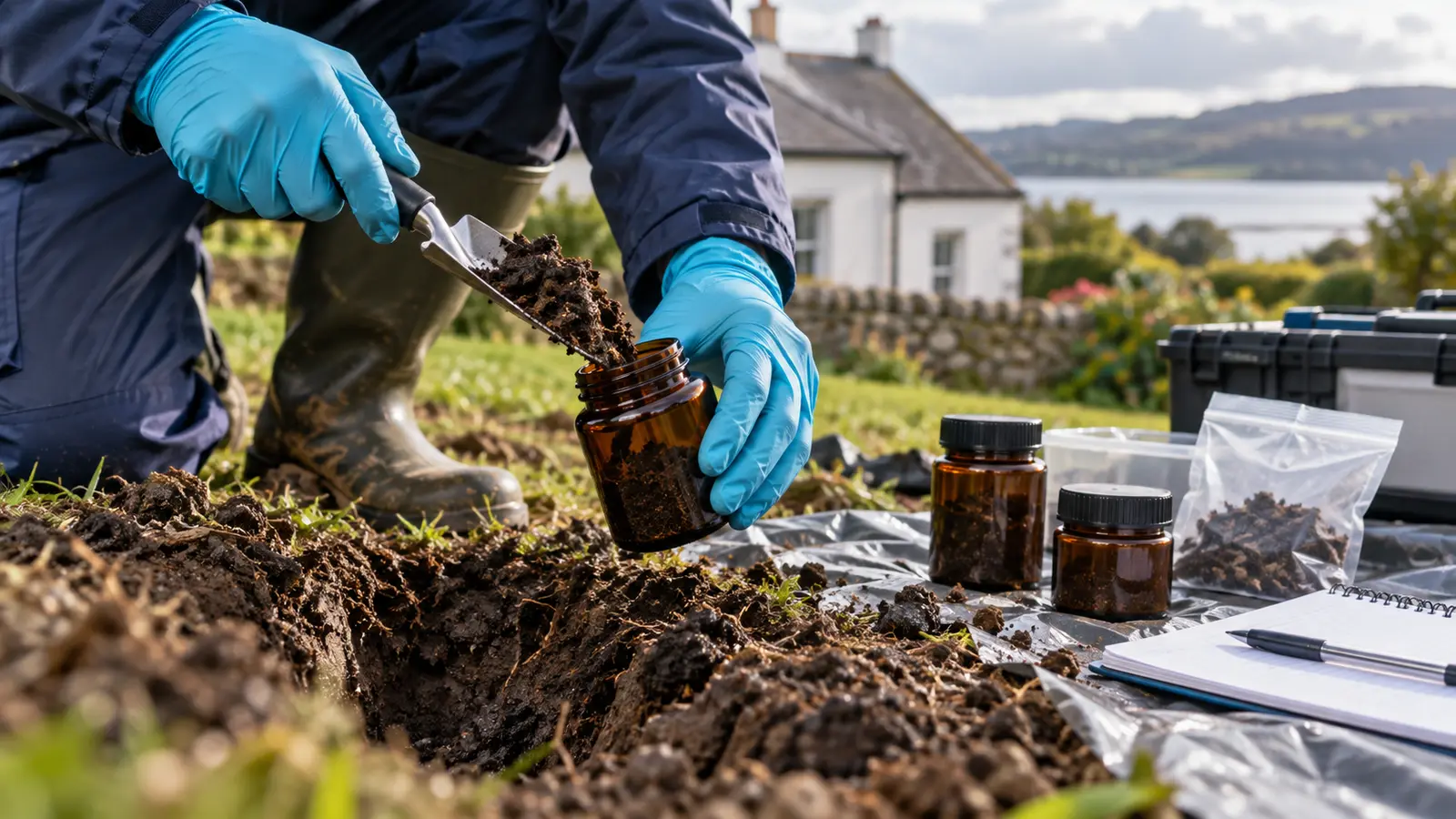
Environmental samples should be collected, labelled, stored, preserved, transported and analysed in a controlled and documented manner.
Depending on the sample type and analytical method, this may include:
- using appropriate sample containers;
- preventing cross-contamination;
- recording the exact sampling location;
- recording the sampling depth;
- assigning a unique sample identification;
- documenting the date and time of collection;
- preserving or chilling the sample where required;
- transporting it within appropriate holding times;
- maintaining a documented chain of custody; and
- submitting it to an appropriately accredited environmental laboratory.
These controls give the analytical data traceability, credibility and evidential value.
A result should be capable of being traced back to a clearly identified:
location + depth + material + sampling event.
If that link is lost, even an analytically accurate result may become difficult to interpret or defend.
Field screening and laboratory analysis are different
Field observations and screening instruments can provide rapid information while an investigation is taking place.
For example, a PID may help identify areas where volatile petroleum compounds are elevated and guide the selection of soil samples.
But field screening does not replace laboratory analysis.
Laboratory testing provides the quantitative chemical evidence needed for formal assessment.
The strongest investigation therefore combines:
field observations + screening data + laboratory results + the conceptual site model.
No single part should be interpreted in isolation.
A number is not a conclusion
When laboratory results are returned, they may be compared with scientifically derived generic assessment or screening criteria.
These provide benchmarks against which contaminant concentrations can be evaluated.
For human-health assessment, the relevant criterion may vary according to land use, such as:
- residential land with gardens and home-grown produce;
- residential land without produce cultivation;
- public open space; or
- commercial or industrial land.
The criteria provide a starting point for risk assessment.
They are not necessarily universal clean-up limits.
Screening criteria and remedial targets are different
This distinction is important.
Generic screening criteria help determine whether a contaminant concentration may require further assessment.
A result above a screening criterion does not automatically mean that all affected soil must be excavated.
It indicates that the potential risk should be considered further.
That may involve:
- additional investigation;
- refinement of the conceptual site model;
- more detailed risk assessment; or
- development of a site-specific remedial objective.
A remedial target is different.
It is derived for the particular site and relates to the source-pathway-receptor linkage that the remediation is intended to address.
The process is therefore more accurately described as:
laboratory result -> screening assessment -> risk assessment -> site-specific remedial objective, where required.
Results must be interpreted in context
A laboratory result should never be considered only as a number on a certificate.
Interpretation may also require consideration of:
- sample location;
- depth;
- soil type;
- groundwater conditions;
- field observations;
- the fuel involved;
- weathering;
- detection limits;
- analytical uncertainty;
- nearby results;
- the conceptual site model; and
- the receptor being assessed.
Petroleum contamination can vary substantially over very short distances.
A low result in one sample does not necessarily demonstrate that surrounding ground is unaffected.
Similarly, an isolated high result may require investigation to understand whether it represents a local hotspot or a wider contamination problem.
Sampling data only becomes meaningful when it is interpreted spatially and environmentally.
“Not detected” does not mean zero
Laboratories have defined limits of detection and reporting.
A result reported as not detected means that the compound was not measured above the laboratory’s applicable reporting threshold.
It does not necessarily mean that absolutely none of the substance is present.
This distinction can become important where very low concentrations are environmentally significant or where results are being compared over time.
Weathering can change what the laboratory finds
Heating oil changes after it is released.
Some components evaporate more readily, some dissolve into water, some biodegrade and others remain preferentially within soil or organic matter.
An older petroleum spill may therefore have a very different analytical profile from fresh fuel.
This means laboratory results should be interpreted alongside:
- the age of the release;
- environmental conditions;
- migration pathways; and
- the expected behaviour of the fuel.
Chemical composition can help with interpretation, but it should not normally be treated as a complete reconstruction of the incident without supporting evidence.
Monitoring over time
A single result provides information about one place at one time.
Repeated observations can provide something different: a trend.
Monitoring may be used to determine whether contamination is:
- stable;
- reducing;
- increasing;
- moving;
- responding to remediation; or
- changing seasonally.
This can be particularly important for groundwater, vapour and in-situ remediation systems.
Monitoring should have an end point
Monitoring should not continue indefinitely without a reason.
A monitoring plan should normally define:
- what is being measured;
- why it is being measured;
- where measurements will be taken;
- how frequently;
- for how long;
- what trend or condition is expected;
- when the results will be reviewed; and
- what evidence will allow monitoring to stop.
The purpose is to answer a question, not simply to accumulate data.
Quality control gives the data credibility
Good environmental decisions depend on good data.
Confidence in the results comes from the whole process:
sampling design -> field collection -> labelling -> preservation -> transport -> laboratory analysis -> interpretation.
A weakness at any stage can reduce confidence in the conclusion.
This is why properly documented sampling and accredited laboratory analysis are important, particularly where the results may later be reviewed by:
- insurers;
- regulators;
- solicitors;
- purchasers;
- lenders; or
- another environmental consultant.
Professional judgement
Sampling is not simply a laboratory exercise.
It is a process of collecting evidence to test the conceptual site model and support a decision.
A consultant should be able to explain:
- why each sample was taken;
- why that location was selected;
- why that depth was relevant;
- why a particular analytical suite was chosen;
- what the result means in the wider site context; and
- how it affects the next stage of the project.
A laboratory certificate on its own cannot tell a homeowner whether a site is safe, whether remediation is required or whether a project is complete.
Those conclusions require the laboratory data to be interpreted alongside the source, pathways, receptors and wider site evidence.
Sampling generates data. Professional interpretation turns that data into evidence.
A spill is happening now?
Prioritise safety.
Stop the source only if it is safe to do so, prevent further spread where practicable, and obtain appropriate professional assistance rather than relying on laboratory testing alone during an active incident.
Read next
- How an oil-spill site is assessed and remediated
- How heating oil can affect groundwater
- Environmental effects of a domestic heating-oil spill
- Oil-spill terms explained in plain English
EDITORIAL INFORMATION
About this guide
Author: Spill-Response Editorial Team
Jurisdiction: Northern Ireland launch version. General technical explanations may also be relevant elsewhere, but reporting duties, official contacts and legal requirements must be checked for the applicable jurisdiction.
Last reviewed: 21 September 2026
Key sources consulted: Environment Agency – LCRM Stage 1: risk assessment; Environment Agency – LCRM Stage 3: remediation and verification; and NI Direct – Oil spills at home.
Review status: Final technical and source review completed for the Northern Ireland launch version.
Limitations: This guide provides general information and is not a substitute for site-specific environmental, legal, insurance or emergency advice.