

HEATING OIL AND FUELS
The type of fuel released influences its behaviour, potential hazards, clean-up considerations and the evidence needed to understand an incident.
The term heating oil can be confusing because it does not always describe exactly the same product in every jurisdiction or application.
In Ireland, kerosene is commonly used as domestic heating oil. Historic or informal trade descriptions such as 20-second, 28-second and 35-second oil may still be encountered. These labels arose from older viscosity test terminology, but usage is not sufficiently consistent to identify a product on its own. In current practice, 28-second oil generally refers to kerosene and 35-second oil to gas oil; any reference to 20-second oil should be confirmed with the supplier or product record.
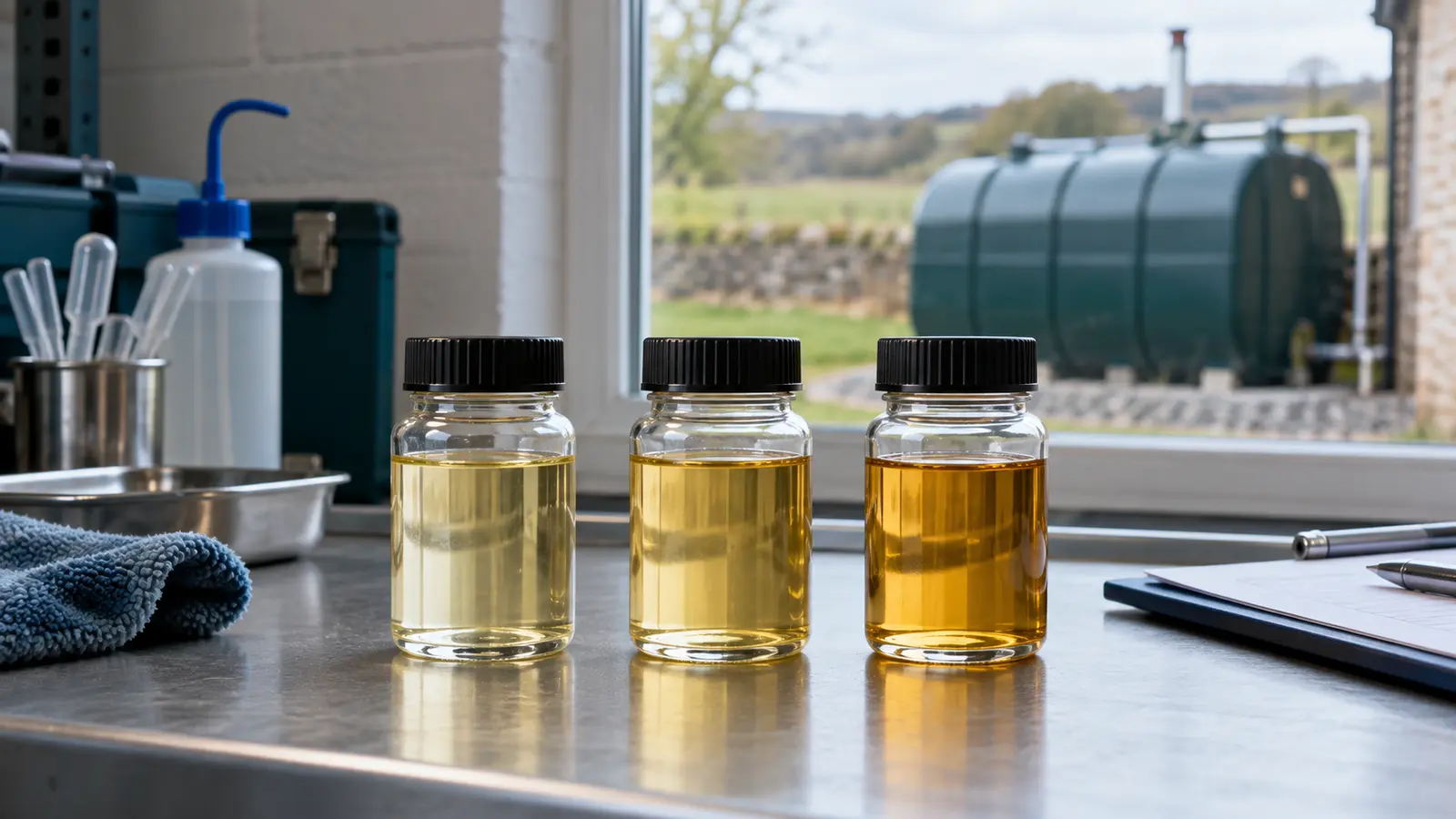
Kerosene may appear clear, pale or yellowish, but dyes, markers, additives, age, contamination and lighting can alter appearance. Colour alone should never be relied upon to identify a petroleum product.
Across Great Britain, kerosene is widely used for domestic heating. The current BS 2869 specification includes Class C2 kerosene for fixed combustion applications. Some larger domestic, commercial or industrial systems may use other fuel-oil grades, including gas-oil-type products. Terms such as red diesel describe fiscal marking or common trade usage and should not be treated as a complete technical identification of the product.
Terminology is not always used consistently by householders, contractors or even within older documentation, so the product involved in a spill should be confirmed from reliable records wherever possible.
START WITH IDENTIFICATION
Why the product matters
Fuel products differ in their composition, volatility, viscosity and the way they weather after being released.
These differences can affect:
- how rapidly oil penetrates soil and building materials;
- how readily it moves through permeable ground;
- the amount and persistence of odour;
- the potential for vapour generation;
- how the product behaves in groundwater or surface water;
- the effectiveness of different recovery and remediation techniques; and
- how environmental samples should be interpreted.
Product identity is therefore part of the initial technical assessment, not simply an administrative detail.
Physical and chemical properties also affect risk
The physical and chemical properties of different fuel oils influence not only how they move through the environment, but also the potential hazards they may present to people and environmental receptors.
Kerosene, gas oil and other petroleum products differ in their composition, volatility, solubility, persistence and toxicological properties.
Those differences can influence the potential for:
- vapour exposure;
- contamination of soil and groundwater;
- impacts on surface water;
- effects on plants and ecological receptors; and
- impacts on building materials and indoor environments.
For this reason, the fuel involved should be identified as accurately as reasonably possible and considered specifically within the site risk assessment.
The risks associated with one petroleum product should not automatically be assumed to be the same as those associated with another.
The product itself is only one part of the assessment. The actual risk will also depend on the quantity released, how long the release continued, the extent to which the product has weathered, the pathways available and the people, buildings, water resources or environmental receptors that may be exposed.
COMMON DOMESTIC CONTEXT
Kerosene in home-heating systems
Kerosene is widely used in domestic heating systems.
Releases may arise from tanks, valves, filters, flexible connections, underground or surface pipework, boilers and delivery incidents.
The arrangement of the heating system and the location of the failure can sometimes be as important as the total quantity of oil lost. A relatively small leak from underground pipework, for example, may continue unnoticed for a considerable period.
The investigation should therefore consider the complete system rather than focusing solely on the storage tank.
The source may not be on your property
Not every oil impact found at a domestic property originates from that property’s own heating system.
Oil can migrate across property boundaries through soil, made ground, drainage routes, service trenches, groundwater or other preferential pathways.
Most commonly, the source may be an adjoining residential property or neighbouring commercial premises. However, under suitable ground conditions, contamination can sometimes migrate from a source further away.
Where oil contamination is found but the property’s own tank, pipework and heating system do not provide an obvious explanation, the possibility of an external source should form part of the investigation.
Identifying where the oil came from may therefore require consideration of neighbouring land, drainage, ground conditions and the wider site history rather than simply examining the affected property in isolation.
DO NOT RELY ON COLOUR
Confirm rather than guess
Colour, smell and informal product names are not sufficiently reliable to identify a fuel definitively.
Useful evidence can include:
- fuel invoices;
- delivery tickets;
- supplier records;
- tank markings;
- appliance or heating-system information;
- safety data sheets; and
- laboratory analysis where necessary.
The appearance of the oil can provide useful contextual information, but it should not be treated as definitive evidence of product identity.
If you are still unsure
If the fuel type remains unclear, contact the fuel supplier or local depot that made the delivery and ask them to confirm exactly what product was supplied.
Supplier and delivery records will usually provide much stronger evidence than attempting to identify the fuel from its colour, smell or appearance alone.
Where the origin of the contamination itself is uncertain, laboratory analysis may assist an appropriately experienced environmental professional. Results must be interpreted alongside delivery records, site history and the degree of weathering; laboratory data may support source attribution but will not always identify one unique source.
AFTER A RELEASE
What should be recorded
Where a heating-oil release has occurred, record as much reliable information as possible.
Useful information includes:
- the product ordered;
- delivery dates and quantities;
- estimated tank contents before and after the incident;
- the heating-system arrangement;
- the suspected failure point;
- how long the release may have continued;
- recent deliveries;
- recent maintenance or repairs;
- changes in fuel consumption;
- observations of odour or staining; and
- any oil or water already recovered from the site.
Preserve invoices, delivery tickets, photographs, correspondence, maintenance records and any other documentation that may later assist in identifying the product or reconstructing what happened.
Where recovered oil, water or other material may later assist technical interpretation, specialist advice should be obtained before it is discarded.
PROFESSIONAL JUDGEMENT
The name of the fuel is only the starting point
In practical spill investigation, terminology can sometimes create more confusion than clarity.
A householder may describe the product simply as heating oil, while a supplier, contractor or laboratory may use terminology such as kerosene, Class C2 kerosene, gas oil, 20-second oil, 28-second oil, 35-second oil or diesel-type fuel. These names are not interchangeable and some are informal or historical.
The important question is not what somebody happens to call the product, but what was actually supplied and released.
That distinction matters because different petroleum products can behave differently after release and may present different risks.
It is also important not to assume that oil discovered at a property must have originated from that property’s own tank. Where the evidence does not fit the apparent source, the investigation should remain open to the possibility of migration from neighbouring land or another external source.
A sound assessment therefore combines:
product identification + source investigation + pathway assessment + receptor assessment.
No single piece of evidence – whether colour, odour, a stain, an empty tank or a neighbour’s tank – should be treated in isolation where the circumstances are uncertain.
A spill is happening now?
Prioritise safety.
Stop the source only if it is safe to do so, take reasonable steps to prevent further spread, and follow the emergency guidance rather than relying on this explanatory article.
READ NEXT
Use the fuel identity in the wider assessment
- See how heating oil can spread
- Understand how heating oil behaves in soil
- Review the potential environmental effects
- Learn how samples and laboratory results are interpreted
EDITORIAL INFORMATION
About this guide
Author: Spill-Response Editorial Team
Jurisdiction: Northern Ireland launch version. General technical explanations may also be relevant elsewhere, but reporting duties, official contacts and legal requirements must be checked for the applicable jurisdiction.
Last reviewed: 22 September 2026
Key sources consulted: UKHSA – Kerosene: general information; UKHSA – Kerosene: toxicological overview; BSI – BS 2869:2023 overview; Environment Agency – Oil storage regulations and oil types; and NI Direct – Oil spills at home.
Review status: Final technical and source review completed for the Northern Ireland launch version.
Limitations: This guide provides general information and is not a substitute for site-specific environmental, legal, insurance or emergency advice.