
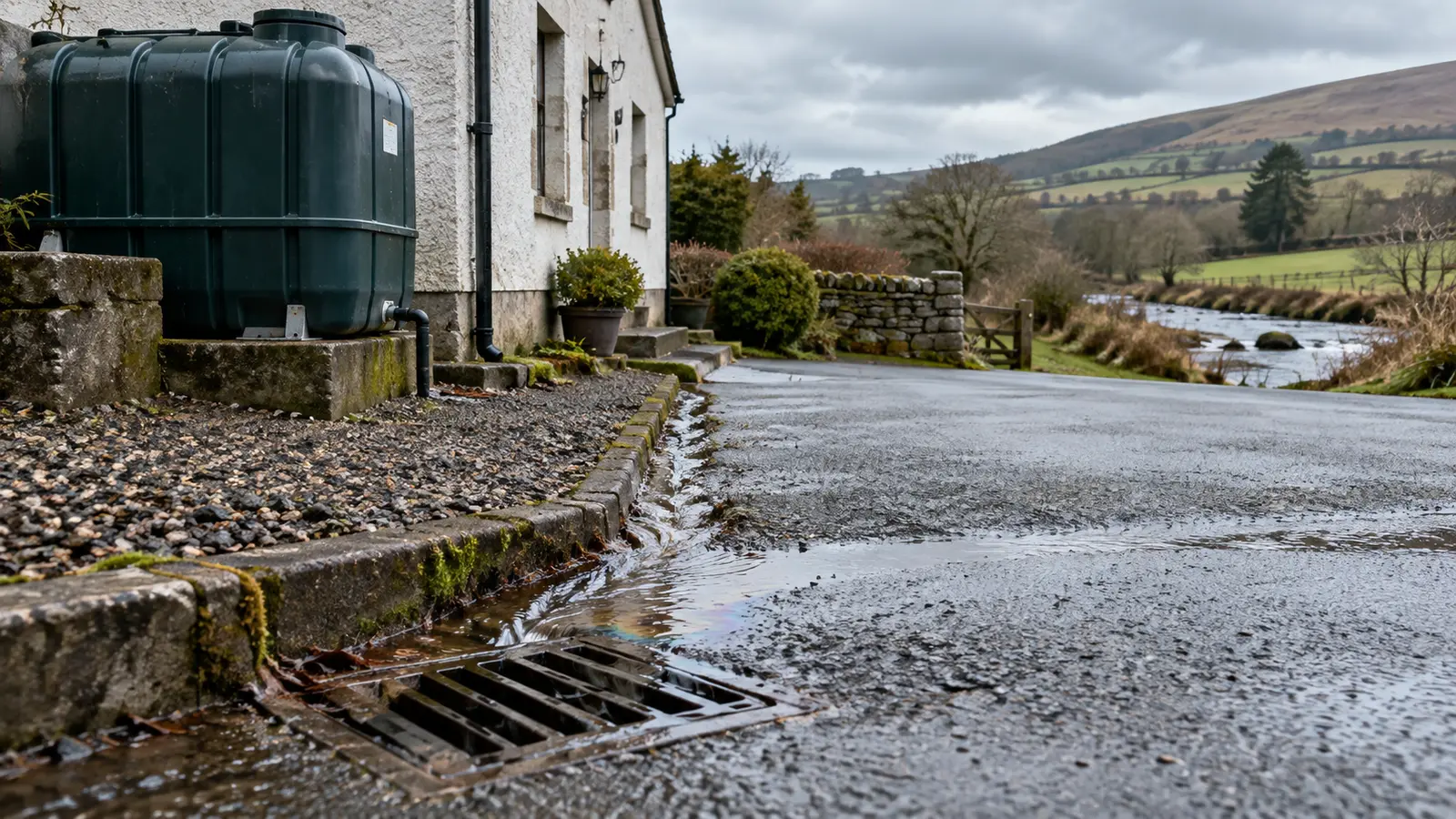

RIVERS, DRAINS AND SURFACE WATER
Drains, ditches, streams and rivers can move heating oil away from the original property extremely quickly.
Migration through soil is often slowed by pore structure, geology and retention within the ground. Once oil enters a flowing drainage system or watercourse, many of those restraints disappear.
A relatively local spill can therefore become an off-site environmental incident within minutes.
Drains can create the fastest migration pathway
Surface-water gullies and drainage systems can transport oil rapidly, particularly during rainfall.
If oil enters a storm drain while water is flowing, it can pass through underground pipework and leave the property before the spill itself has been fully discovered or understood.
Once discharged into a ditch, stream or river, contamination can then travel considerable distances downstream.
For this reason, drains should be one of the first pathways assessed when an oil spill is discovered.
The fact that oil has disappeared from view does not mean that it has been dealt with.
Washing oil away is not cleaning it up. It is moving the contamination somewhere else.
Not all drains lead to the same place
Understanding the drainage system is important because apparently similar gullies and pipes can have very different destinations.
Surface-water drainage
Surface-water systems principally carry rainfall from roofs, roads, yards and paved areas.
Depending on the property, they may discharge to:
- a stream, river or ditch;
- another surface-water drainage system;
- an attenuation or treatment feature; or
- the ground through an infiltration system.
Where there is a direct connection to surface water, oil entering the drain can rapidly become a wider environmental incident.
Oil may also migrate through the granular bedding and backfill surrounding drainage pipes without actually entering the pipe itself.
Foul drainage
Foul drainage carries wastewater from toilets, bathrooms, kitchens, washing machines and other domestic uses.
Where a property is connected to the public sewer network, this wastewater is normally conveyed towards a wastewater treatment works.
Oil entering a foul sewer therefore creates a different pathway from oil entering a surface-water drain, but it should still be treated seriously. Petroleum contamination may travel through the sewer network and potentially interfere with downstream infrastructure or treatment processes.
Combined sewer systems
Some areas use combined sewers, where foul wastewater and storm water are carried within the same sewer network.
This means that a drain receiving rainwater may ultimately connect to the same system carrying domestic sewage.
The actual destination of a drain should therefore be established wherever possible rather than assumed.
Private septic systems
Rural properties that are not connected to the public sewer may use a septic tank or another private wastewater treatment system.
A septic tank receives foul wastewater. Solids settle and biological processes begin breaking down organic material before the partially treated liquid passes onwards to a drainage field or another authorised discharge arrangement.
Oil entering a septic system can disrupt biological treatment and may subsequently pass into the drainage field, creating a pathway into surrounding soil and potentially groundwater.
Surface water should not normally be directed into a conventional septic tank because excessive water can interfere with its operation.
Soakaways and infiltration systems
Rainwater may instead enter a soakaway or other infiltration structure.
These systems temporarily store water and allow it to infiltrate into the surrounding ground.
If heating oil enters a soakaway, it can be delivered directly into permeable material beneath the surface, potentially creating substantial subsurface contamination with little visible evidence above ground.
A surface-water soakaway should be distinguished from the drainage field associated with a septic system, although both ultimately involve infiltration through the ground.
The first question is: where does the drain go?
A gully beside an oil tank might ultimately discharge to:
- a stream;
- a public sewer;
- a soakaway;
- another part of the property; or
- an unknown drainage network.
Those possibilities create very different risks.
Where possible, establish:
- which drains are present;
- whether oil has entered them;
- whether they are surface-water, foul or combined drains;
- the direction of flow;
- accessible inspection chambers;
- where the system discharges; and
- what lies downstream.
Once oil disappears down a drain, the spill has not disappeared. The location of the problem has changed.
What happens when oil reaches surface water?
Heating oil is generally less dense than water and can spread rapidly across the water surface.
It may:
- form a visible sheen;
- spread downstream with the flow;
- accumulate against vegetation or riverbanks;
- collect in quieter areas;
- become trapped around structures;
- enter sediments or bank material; or
- continue into downstream drainage and water systems.
Wind, rainfall, flow rate, channel geometry, bridges, culverts and vegetation can all influence where the contamination travels.
The visible sheen may therefore extend far beyond the original spill location.
Do not use detergents or household surfactants
Household detergents, washing-up liquid and similar surfactants should not be used to disperse an oil spill.
They can break a visible oil layer into much smaller droplets and disperse those droplets into the water.
This may:
- make the oil harder to recover;
- increase its mobility;
- spread contamination over a wider area;
- expose more water and sediment; and
- increase the eventual complexity and cost of remediation.
A small visible spill on a patio can become a much larger environmental problem if it is washed into a drain.
Do not hose oil towards a drain and do not apply household detergent simply to remove the visible stain.
Specialist dispersants have particular applications but should not be used by householders unless specifically directed by an appropriate authority or competent spill-response professional.
Containment must not create another hazard
The immediate priorities are:
Stop or reduce the source, where this can be done safely.
Prevent further spreading.
Protect drains and watercourses.
Escalate promptly if oil has already entered drainage or surface water.
Where oil remains on a hard surface, suitable oil-absorbent materials can be placed ahead of the advancing spill.
Purpose-designed absorbent pads, granules, booms or drain covers may also help where they are available and can be deployed safely.
The objective is to get ahead of the spill, rather than washing or pushing it onwards.
Containment should not be improvised in a way that creates flooding, forces oil towards another property or directs contamination into a different receptor.
Oil-contaminated absorbent materials should be collected and disposed of appropriately.
If oil has already entered a drain
Where oil is known or suspected to have entered drainage, try to establish:
- which drain is affected;
- the likely drainage type;
- which direction the system flows;
- where it may discharge;
- whether inspection chambers show visible oil;
- whether surface water may be affected;
- whether neighbouring property could be threatened;
- approximately how much oil may have been lost; and
- when the release occurred.
Do not delay an urgent response simply because the complete drainage route is unknown.
Where there is a credible pathway to surface water or another sensitive receptor, the relevant environmental or drainage authority should be informed promptly. In Northern Ireland, official guidance states that NIEA must be contacted immediately if oil has entered, or could enter, drains or the water environment.
Reporting duties, contacts and terminology differ between jurisdictions. This Northern Ireland launch version links to the current official guidance; separate jurisdiction-specific guidance should be checked before relying on it elsewhere.
Record the route and changing conditions
Useful evidence includes:
- estimated quantity released;
- discovery time;
- tank level and recent deliveries;
- photographs and videos;
- affected gullies and drains;
- oil visible in inspection chambers;
- direction of drainage;
- nearby streams, ditches, ponds or rivers;
- neighbouring properties potentially affected;
- rainfall and weather conditions;
- visible sheen or odour downstream; and
- containment or recovery actions already taken.
Even where the drainage network cannot be fully mapped, this information can be extremely valuable.
A contractor or environmental authority arriving at the property initially knows very little about the incident. The more reliable information available before they arrive, the better prepared they can be to respond effectively.
Professional judgement
Once heating oil enters drainage or flowing water, time becomes particularly important.
Soil can slow, redirect and retain oil.
A flowing drain can transport it off site in minutes.
An oil spill should therefore never be assessed only at the tank or visible stain. Drainage routes and downstream receptors should form part of the earliest assessment.
Where oil has entered a drain, the objective is not simply to find where the visible oil went. It is to understand:
where the drainage system leads, how quickly the contamination may have travelled, and what could now be affected downstream.
A spill is happening now?
Prioritise safety.
Stop the source only if it is safe to do so, prevent further spread where practicable, protect drains and watercourses, and obtain appropriate emergency assistance where oil may already have entered drainage or surface water.
Read next
- How domestic heating-oil spills spread
- How heating oil can affect groundwater
- Environmental effects of a domestic heating-oil spill
- Who may need to be notified after an oil spill?
EDITORIAL INFORMATION
About this guide
Author: Spill-Response Editorial Team
Jurisdiction: Northern Ireland launch version. General technical explanations may also be relevant elsewhere, but reporting duties, official contacts and legal requirements must be checked for the applicable jurisdiction.
Last reviewed: 22 September 2026
Key sources consulted: NI Direct – Oil spills at home; DAERA/NIEA – Pollution; UKHSA – Kerosene: general information.
Review status: Final technical and source review completed for the Northern Ireland launch version.
Limitations: This guide provides general information and is not a substitute for site-specific environmental, legal, insurance or emergency advice.